
Imposters have been around as long as high society has existed. In 1925, a swindler named Victor Lustig sold the Eiffel Tower -twice- to Parisian businessmen who never questioned their credentials. Almost a century later, in the salons of Mayfair or the terraces of Cap Ferrat, the sophistication of fraud has evolved, but the need to verify identities remains. The difference is that today, in the world of the exclusive and high level dating, To do so without looking like a Scotland Yard inspector requires a special art.
You are at a private soirée in Saint-Tropez. The stranger next to you casually mentions his Rothko collection and his vineyards in Burgundy. His suit is impeccable, his conversation smooth. But something in the way he pronounces «Château Latour» makes you hesitate. How do you verify without turning a potential connection into a police interrogation? The answer lies in understanding that discrete verification is social protocol, not paranoia.

The Art of Conversation as a Verification Tool
The first barrier against impostors is not Google, but your ability to hold a conversation with strata. When someone claims to belong to certain circles, shared cultural references work like invisible passwords. It's not about memorizing lists of Michelin restaurants, but rather about understand linguistic codes that can only be acquired through genuine experience.
If he mentions his childhood in Geneva, ask him about that historic confectionery shop on Rue du Rhône where they serve the finest marrons glacés. If he talks about the season in Aspen, he comments on the change at Buttermilk after the 2018 renovation. Specific details-not obvious places-reveal authenticity. As Truman Capote observed: «The difference between ordinary people and extraordinary people is that extraordinary people know the details.»
But here's a crucial nuance that I discovered after years of navigating these environments: some genuinely private individuals may appear to be evasive. I have known real heirs who intentionally avoid mentioning their last name on first dates, not out of fraud, but out of weariness of being defined by it. The difference is in emotional consistency: real stories have textures, minor contradictions, humanity. The fabricated ones sound polished to the point of implausibility.
The Strategic Questions That Never Fail
Over dinner at Harry's Bar in Venice, watch how he responds to these approaches:
- «What do you think of the change in [recent exclusive event]?» - Real attendees have formed opinions, often critical.
- «I would love to know your perspective on [specific topic of your supposed industry].» - The depth of the answer reveals real experience versus superficial knowledge of Wikipedia.
- «Where do you prefer to escape to when you really need to disconnect?» - Authentic people mention specific places with sensory details, not magazine cover destinations.

Digital Archaeology Without Becoming a Stalker
Social networks are a minefield of information, but the key is in discrete triangulation. It is not a matter of studying every published photo - that is obvious and clumsy - but of looking for patterns of authenticity that impostors cannot easily fabricate.
True wealth leaves specific digital footprints: appearances on charitable foundation boards, mentions in obituaries of prominent relatives (the wealthy keep meticulous genealogical records), photographs at events where the guest list is verifiable. I have found that Forbes and similar publications are invaluable resources for verifying legitimate executives and entrepreneurs.
But it's not the glamorous photos that are most revealing. secondary connections. Who comments on their posts, are they profiles with long and verifiable histories, or recent accounts without substance? In the ecosystem of luxury dating, real networks are built over decades, not months.
«In high society, your network is your unauthorized biography.» - This was once said to me by Carolina Herrera during an event in New York, and I have never forgotten it.
One technique I use: look for chronological inconsistencies. If you claim to have studied at Oxford from 2008 to 2012, but have photos «living in Hong Kong» during that period without explanation, there's something wrong. Imposters rarely maintain consistent timelines across multiple platforms.
The Impeccable Profiles Trap
Paradoxically, a social profile too perfect is usually a warning sign. True generational richness has a relaxed, almost careless quality. Photos are out of focus because they were taken by a friend during a genuine moment, not by a photographer hired to fabricate an image. I've seen imposters with Instagram feeds that look like Condé Nast catalogs-beautiful but soulless-while authentic profiles have that casual jaggedness that only real life provides.

The Power of Mutual Connections as a Social Verifier
In the really exclusive circles, there is what I call «the principle of the three degrees of separation».». If someone is legitimate, you can draw a line between you through no more than three verifiable people. This is not coincidence; it is the closed nature of these worlds.
During an evening at Claridge's, he casually mentions someone in your circle that he might know in common. «Do you know Alessandro, the guy who runs that gallery on Via Montenapoleone?» The genuine answer includes specific details, «Yes, we met at the 2019 Biennale, he has a Golden Retriever named Cosimo.» The fake one is vague: «I think I've seen him at some event.»
But there is an art to this verification: never make the other person feel that he/she is being examined.. Integrate these references naturally into the conversational flow, as part of your own narrative. «I just came back from Milan where Alessandro showed me an amazing piece by Fontana» sounds genuine. «Do you know Alessandro from Milan?» sounds like an interrogation.
When Extreme Privacy is Legitimate
I have learned to distinguish between suspicious secrecy and genuine discretion. Families with real wealth-especially European ones-often practice what the French call «richesse discrète». They do not publish photos of their properties, avoid mentioning specific figures, and can appear evasive because they have been trained since infancy to protect their privacy.
The difference is in consistency. The private but genuine person maintains his or her reserve on all sensitive issues. The impostor is selectively evasive: vague about his or her heritage but specific about less verifiable things. Notice where silences fall in conversation.
Behavioral Indicators That Cannot Be Falsified
There is an ineffable quality in those who have grown up in environments of true privilege: a quiet confidence that needs no testing. As Coco Chanel said: «Elegance is when the inside is as beautiful as the outside.» This inner elegance manifests itself in details that impostors rarely master.
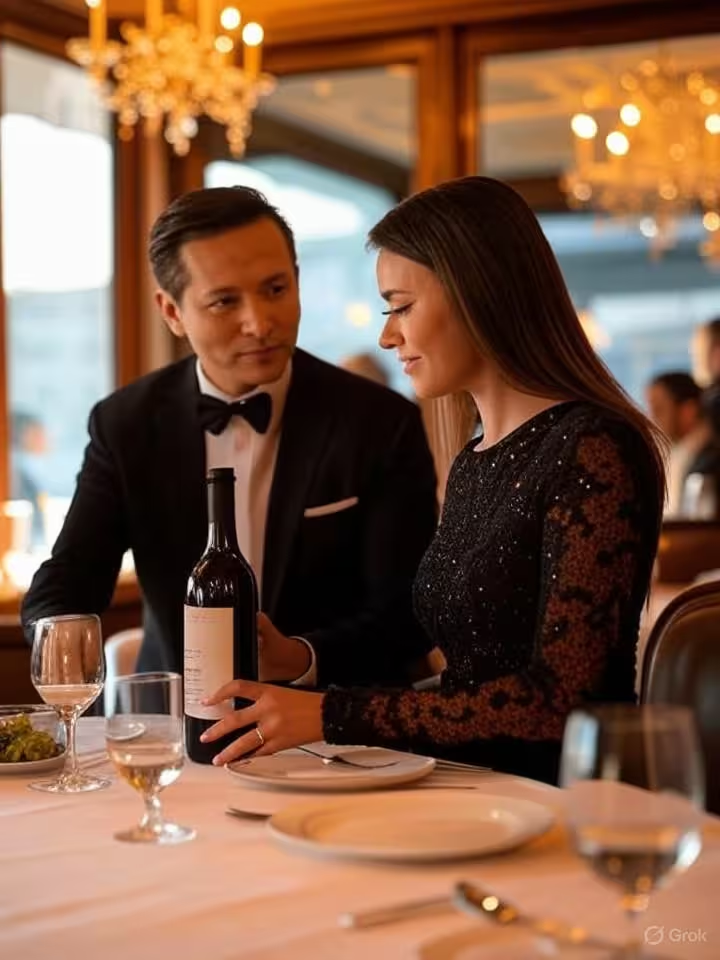
Observe how he interacts with the wait staff. Is there genuine respect or performative condescension? During a dinner at Le Bernardin, note whether he knows the difference between a Montrachet and a Meursault without consulting the label. At the Ritz in Paris, do you walk with the familiarity of someone who has been there dozens of times, or with the nervous excitement of a tourist?
Revealing details include:
- Protocol management without ostentation - He knows exactly which fork to use, but does not point it out.
- Organic cultural references - He quotes Proust because he read him, not because he wants to impress.
- Long-term relationships with facilities - The sommelier greets you by name in this «secret» restaurant on the Rive Gauche.
- Knowledge of historical nuances - Not only does he know that Cartier is prestigious, but why the Tutti Frutti design revolutionized jewelry in the 1920s.
During years of observation, I have noticed that true connoisseurs rarely need to explain their knowledge. They live it. When someone tells you at length why their watch is valuable, they probably just acquired it. Someone who inherited it from their grandfather simply wears it.
The Body Language of Genuine Privilege
There is a specific posture - relaxed but upright - that comes from generations of good manners taught from childhood. It is not military stiffness, but a natural grace. I have seen impostors try to imitate it and fail consistently because they the body memorizes decades of unconscious training that cannot be replicated in months of preparation.

Formal Tools: When and How to Use Them
Sometimes, intuition and observation are not enough. This is where professional verification services come in, but with one crucial caveat: use them with extreme discretion and only when the stakes justify it.. If you are considering a serious relationship or joint investment, due diligence is prudent, not paranoid.
The rules of etiquette in these circles dictate that you hire services through reliable references. Large law firms have discreet departments that run background checks without leaving obvious fingerprints. They look for:
- Real estate registries in key jurisdictions
- Corporate shareholdings and directories
- Previous litigation or bankruptcy
- Verification of academic and professional qualifications
- Cross-references in historical social records
But I openly acknowledge: this path has emotional costs. I have seen promising relationships wither under the weight of formal verification. There is something fundamentally incompatible between romantic intimacy and vetting. Use it as a last resort, not a first step.
The Ethics of Verification
There's an uncomfortable honesty here: verifying someone implies a certain violation of trust. You're essentially saying «I don't completely believe in you.» Is this compatible with starting an authentic relationship? The answer is not simple.
My perspective, after years in these environments: basic verification is reasonable self-protection; deep investigation without cause is corrosive. Seek balance. As Oscar Wilde said: «Trust is for the naive; verification is for the wise.» Although, ironically, he never said exactly that-perfectly illustrating why we check even the quotes.
When Red Signals Are Obvious
Sometimes, verification reveals inconsistencies that cannot be ignored. How to proceed without creating a scandal? Discretion works both ways. If you discover that someone is not who they claim to be, graceful retreat is preferable to dramatic confrontation.
One technique I have used: the «reverse escalation» of engagement. Gradually reduce the intensity of interactions without detailed explanations. In these circles, people understand eloquent silences. You don't need to publicly denounce an imposter - that makes you look vindictive - just drop him or her from your social orbit.
However, there is an exception: if someone is committing active fraud that may harm others in your circle, you have a social responsibility. Discreetly alerting event organizers or private club managers is part of the unwritten code of mutual protection that keeps these spaces safe.
Building Trust As You Verify
The paradox of the exclusive dating is that you require emotional openness and strategic protection simultaneously. How do you reconcile the two? The answer lies in the gradual verification correlated with escalation of commitment.
On first dates, rely on observation and conversation. If the relationship progresses to something more serious, allow your level of verification to increase proportionately. You don't need a full background report to sip champagne at the Ritz; you do before you consider merging estates.
This layered approach respects both your safety and the natural development of intimacy. As the Duchess of Windsor observed: «You can never be too rich or too thin.» -though I would add, you can never be too careful, as long as it's not at the expense of your humanity.
The Intuitive Factor That No Verification Replaces
After all the strategies, tools and techniques, there is an irreducible element: your intuition refined by experience. I have rejected connections that passed all the formal checks because something in my gut said «no». Other times, I have trusted people who looked questionable on paper, and they turned out to be genuine.
True luxury includes the ability to take calculated risks. If you completely eliminate risk, you also eliminate the possibility of extraordinary connections. The difference between prudence and paranoia is in know when your precautions protect you versus when they isolate you.
As Anaïs Nin said: «Life contracts or expands in proportion to one's courage.» In the context of high-level relationships, this means having the courage to verify when necessary, and the courage to trust when you feel it is appropriate.
Environments Where Verification Is Easiest
Not all luxury spaces are equal for verifying identities. Some environments have built-in verification mechanisms that make your job easier:
- Private clubs with strict memberships - The Soho House, Annabel's, or the Core Club have already done a preliminary check.
- High-end charity events - Tables cost tens of thousands; organizers verify financial capacity.
- Art auctions in prestigious houses - Christie's and Sotheby's require credit verification to participate.
- Ultra-exclusive resorts - If you met him at Aman or Cheval Blanc, at least you know he can afford those rates.
These natural filters are not infallible - money does not guarantee emotional authenticity - but they eliminate certain categories of impostors.
Final Reflection: Authenticity as a Supreme Value
Ultimately, all this discussion of verification points to a deeper value: mutual authenticity as the foundation of any meaningful relationship. If you're checking up on others, ask yourself if you're being completely authentic, too. Truly extraordinary connections-those that transcend mere social or romantic transaction-only occur when both parties genuinely show up.
Discrete verification is not cynicism; it is the necessary refinement to protect something valuable: your ability to connect deeply. By filtering out the fake, you create space for the real. And in a world where authentic luxury is becoming increasingly rare, that verified authenticity is, paradoxically, true luxury.
As Coco Chanel said with her characteristic precision: «Fashion passes, style remains.» The same applies to relationships: superficial connections pass, but those built on authentic foundations - verifiable but genuine - remain and deepen over time. That permanence, that real depth, is what we all really seek when we navigate these golden circles.


 English
  Spanish
  French
  Portuguese
  Italian
  German