
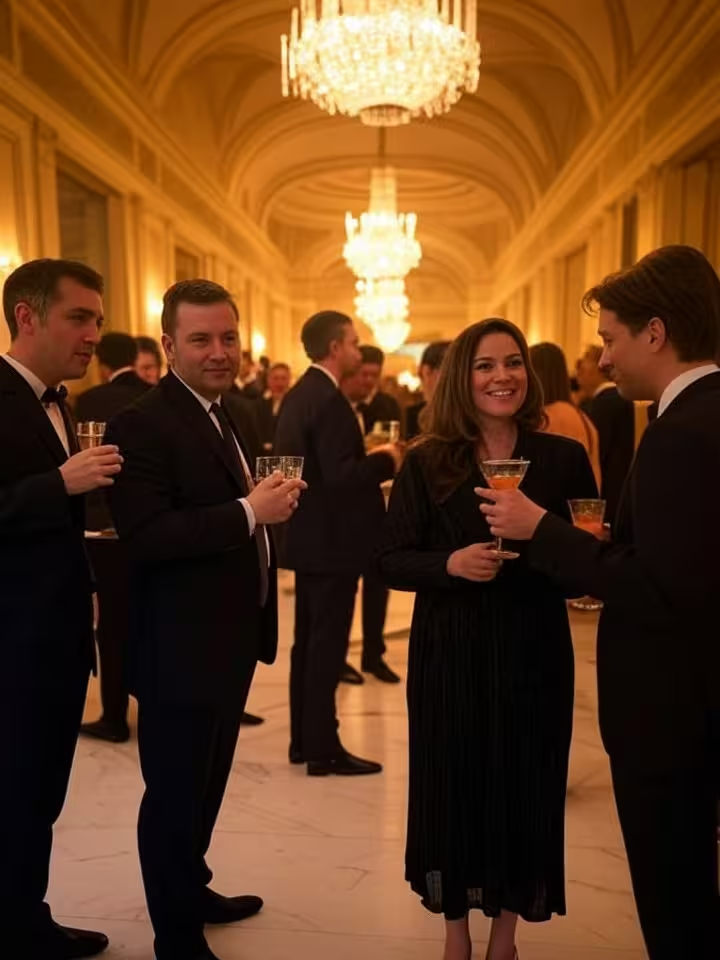
There is a precise moment when you realize that protocol is not a collection of arbitrary rules, but a signaling system as sophisticated as Morse code. It usually happens at your first international gala, when someone casually mentions an English term that everyone understands but you, and you suddenly feel that invisible fissure between those who belong and those who are still learning. The fascinating thing about English protocol vocabulary is not its linguistic complexity, but its ability to act as a master key in environments where access is not bought with money, but with cultural knowledge.
The Invisible Language of Access: Why Protocol Vocabulary Matters More than You Think
During the Belle Époque, European high society developed a coded language so elaborate that a single business card could convey up to seven different messages depending on how you turned the corner. That tradition of sophisticated communication never disappeared; it simply migrated to English as the lingua franca of international luxury. As he wrote Cecil Beaton, British royal photographer and social chronicler: «Being chic is not only knowing what to do, but doing it so naturally that no one notices you know.»
The protocol vocabulary in English works exactly like this: when you master it, no one notices the effort; when you ignore it, every social interaction becomes a minefield. I've observed this repeatedly at high-profile events, from Christie's auctions to private dinners at Mediterranean villas. The difference between those who flow naturally and those who constantly look for cues lies not in their bank account, but in their fluency with these cultural codes.
What makes this vocabulary particularly relevant in the context of the high-level dating is its dual function: it communicates social competence while conveying respect for shared conventions. When someone correctly uses terms such as «dress code» o «reception line«You are subconsciously signaling that you understand the rules of the game, and in exclusive circles, that understanding is worth as much as any professional credential.
RSVP and the Lost Art of Elegant Confirmation
Let's start with the term that causes more problems than it should: RSVP, from French «Répondez s'il vous plaît.» (please respond). In theory, it's simple: you receive an invitation, you RSVP. In practice, this seemingly innocent acronym has become a test of social competence that many fail miserably.
Brutal honesty is this: ignoring an RSVP is not a minor oversight, it is a declaration of social incompetence.. In upscale circles, hosts keep mental (and sometimes physical) lists of those who respect this basic protocol. An event organizer in Monaco once confessed to me that she has an «informal blacklist» of people who systematically ignore RSVPs, and simply stop receiving them. There is no drama, no confrontation; they simply disappear from the social radar.
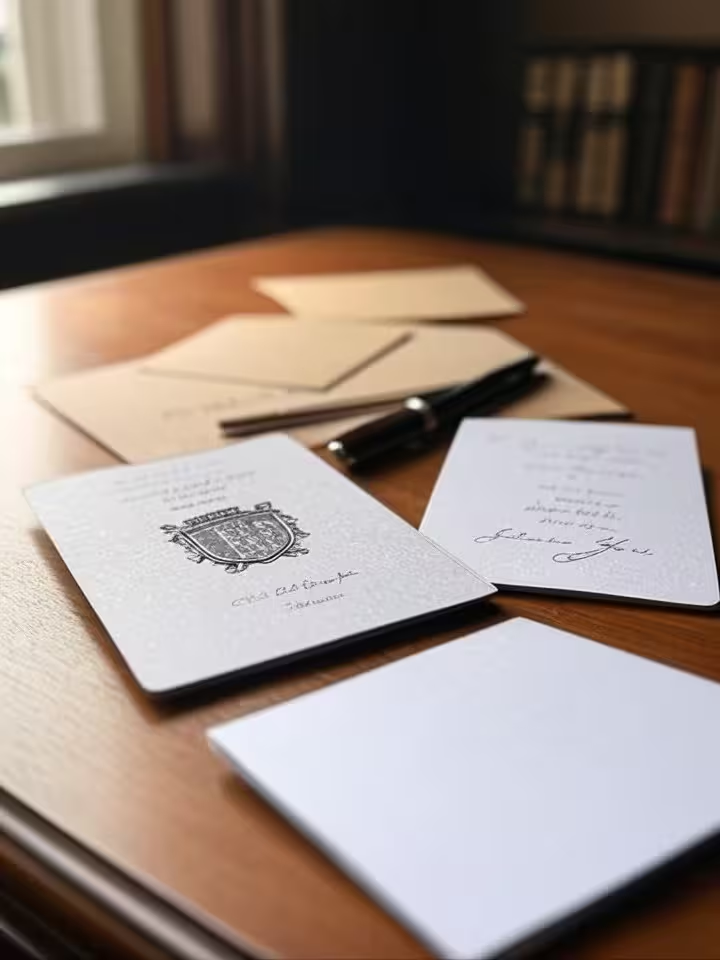
But there are nuances that elevate your answer from correct to memorable:
- Timing matters disproportionately: Responding within 24-48 hours positions you as thoughtful and organized. Waiting until the last day allowed marks you as someone who is probably waiting for a better invitation.
- The medium also communicates: For formal events, a written response (even if it is email) shows greater consideration than a text message, although the latter has become acceptable in less formal contexts.
- The formulation reveals your sophistication: Instead of a terse «Yes, I'll attend,» consider something like «.«I'm delighted to accept your kind invitation»for very formal events, or «Count me in, looking forward to it»for more relaxed occasions.
In the context of the exclusive dating, RSVP takes on an additional dimension. An invitation to a private dinner or cultural event is not merely social; it is an investment of emotional and logistical capital. Promptly confirming and keeping your word builds the reputation for reliability that is critical in circles where social etiquette defines access.
When You Need to Decline: The Right Way to Say No
This is where many make costly mistakes. Declining an invitation requires as much finesse as accepting it. The formula is: gratitude + brief reason (optional) + hope for future encounter. For example: «Thank you so much for thinking of me. Unfortunately, I have a prior commitment that evening. I do hope we can connect soon.«
What you should never do is leave the host in uncertainty or make up elaborate excuses that can later be disproved by your social networks. In 2019, Vanity Fair published a fascinating analysis of how social networks have destroyed the credibility of traditional excuses in elite social circles.
Dress Codes: Deciphering the Language of Formal Wear
If the RSVP is the gateway, the dress code is the entrance exam. And this is where English vocabulary becomes especially treacherous, because seemingly interchangeable terms have subtle but critical differences.
«Black Tie» is perhaps the most iconic, but also the most misunderstood. It does not mean «fancy dark suit»; it means specifically. tuxedo (tuxedo in American English) for men and long or very formal dress for women. The designer Tom Ford, who has been dressing the global elite for decades, put it perfectly: «Black tie is non-negotiable. You either get it, or you're out of line. There is no middle ground.»
Non-negotiable components of the men's black tie include:
- Tuxedo jacket (traditionally with silk or satin lapels)
- Pants with silk side stripe
- White shirt with pleated or plain breastplate
- Black bow tie (preferably hand-knotted, not clip-on)
- Sash or vest (cummerbund or waistcoat)
- Black patent leather shoes
For women, black tie offers more creative flexibility, but the general rule is: long dress or sophisticated evening ensemble. Short dresses, however elegant they may be, do not technically meet the strict black tie code, although in more relaxed contexts they may be acceptable if they are exceptionally formal.
White Tie: The Everest of Formalism
If black tie intimidates, «White Tie» terrifying. It is the highest level of formality in Western dress, reserved for state galas, historic opera balls and truly exceptional occasions. It requires full tailcoat for men (with all its specific components: white vest, white bow tie, patent leather shoes) and long ball gown with formal jewelry for women.
The honest reality is that most people will never attend a white tie event in their lifetime. But knowing its existence and significance protects you from making the mistake of overestimating the formality of other events. As an event planner in London once told me: «If the invitation doesn't explicitly say ‘white tie’, it's definitely not. It's the one dress code that is never assumed.»
Cocktail Attire: The Perfect Balance
«Cocktail attire» is probably the most common dress code at modern luxury events and, paradoxically, one of the most confusing. The key is to understand its historical origin: it emerged in the 1920s-1930s as a category between daytime casual and evening formal, designed specifically for cocktail receptions between 5 pm and 8 pm.
In modern practical terms, cocktail attire means:
- For men: Dark suit (not necessarily black), dress shirt, tie. Tuxedo is excessive; jeans are unacceptable.
- For women: Elegant short or long dress, sophisticated outfit. It is the dress code that allows greater personal expression within the limits of good taste.
In the context of the high-level dating, cocktail attire is your ally: it allows you to look elegant without the rigidity of the black tie, giving you room to show personality and style. It is the perfect dress code for extraordinary experiences in exclusive restaurants or private cultural events.
Social Etiquette Terms: The Vocabulary of Refined Interactions
Beyond dress, there is a whole lexicon related to behavior and social interactions that separates those who flow naturally in upscale environments from those who constantly commit small faux pas.
Faux Pas: The Mistakes Everyone Noticed but No One Mentions
«Faux pas» (pronounced «foh pah» in English) literally means «faux pas» in French, but in protocol vocabulary it describes any social faux pas that violates the unwritten rules of elegant behavior. The insidious thing about faux pas is that they are rarely explicitly mentioned; they just quietly disqualify you.
The most common faux pas in luxury circles include:
- Arriving significantly late without prior notice (in formal contexts, 5-10 minutes is the maximum acceptable)
- Using the cell phone during meals or conversations
- Monopolizing conversations without reading social signals
- Discussing inappropriate topics (divisive politics, personal finances, detailed health issues)
- Demonstrate a basic lack of knowledge of formal table service.
- Photographing or videotaping without explicit permission
In exclusive dating events, there is a particularly destructive faux pas that I have observed repeatedly: bragging about connections, possessions or experiences. The true elite never need to advertise their status; it is assumed by their behavior, knowledge and naturalness. As the writer observed Edith Wharton on the high society of his time: «The real distinction lies in what one never needs to mention.»
Discretion: The Supreme Value of Exclusive Circles
«Discretion» is not simply keeping secrets; it is a whole philosophy on how to navigate privileged spaces without compromising the privacy of others or one's own. In the age of social media and oversharing culture, discretion has paradoxically become the ultimate luxury.
Operational discretion in high-level circles means:
- Do not photograph or publicly mention who attends private events.
- Do not share details of confidential conversations, even if confidentiality was not explicitly requested.
- Do not use social associations as a bargaining chip («As I was telling Prince X...»).
- Keeping romantic relationships out of the public eye until both parties agree otherwise
In the millionaire dating, discretion is not optional; it is the price of entry. People of high net worth and public profile value their privacy disproportionately precisely because it is constantly threatened. Demonstrating that you understand and respect this value immediately differentiates you from those who seek association to raise their own profile.
Vocabulary for Events and Formal Meetings
Luxury events have their own taxonomy, and confusing one type of event with another can lead you to prepare inadequately or completely misunderstand the nature of the occasion.
Soirée: More than an Elegant Party
«Soirée» (from the French «evening») describes a sophisticated evening gathering, typically more intimate and refined than a conventional party. A soirée implies quality conversation, carefully curated ambiance and guests selected for their ability to contribute to the overall ambiance.
What distinguishes a soirée from a simple «party» is its intention: it is not merely entertainment, but the creation of a space for meaningful connections. The novelist Marcel Proust, a master at describing Parisian salons, wrote: «The best rooms are not those where the most important people gather, but where the most interesting conversations occur.»
In the context of high-end dating, being invited to a private soirée is a sign of considerable confidence. The host is essentially saying, «I trust you to elevate, not diminish, the quality of the evening.» Reciprocating that trust requires:
- Arrive prepared for substantive conversations, not just superficial talk
- Contribute without dominating, allowing everyone to shine
- Respecting the private nature of the event (here discretion returns)
- Thank the host in a memorable way (a handwritten note is still the gold standard)
Reception Line: The Social Ballet of Formal Presentations
A «reception line» is that formation where the hosts (and sometimes guests of honor) position themselves to greet each attendee individually. Common at weddings, charity galas and diplomatic events, it has specific rules that many are unaware of:
- Keep your greeting brief (15-30 seconds maximum); there is a line behind you.
- Greetings in order, from left to right as you approach
- Briefly introduce your companion if the host does not know you
- Do not initiate prolonged conversations; There will be time later
- If you don't remember the name of someone on the line, don't make it up.; a polite «Wonderful to see you again» works
I have observed how people who perfectly navigate a reception line gain instant credibility, while those who ignore these conventions create awkward bottlenecks that everyone remembers negatively.
Plus One: The Choice that Defines Perceptions
When an invitation specifies «plus one», You are receiving permission to bring a companion, but this apparent simplicity masks significant social complications. Your choice of plus one communicates as much about you as your own presence.
Critical considerations when choosing a plus one:
- Contextual compatibility: Will your companion feel comfortable and contribute positively to the environment?
- Relationship level: Taking someone very new can create unnecessary pressure; taking someone very familiar can send unwanted signals.
- Protocol knowledge: Does your escort understand the conventions of the event or will they require constant guidance?
- The option to go alone: Sometimes, introducing yourself without plus one projects confidence and emotional availability, especially in dating contexts.
The reality that nobody mentions: taking the wrong plus one is worse than going alone. An event planner in New York told me about an executive who brought an inappropriate date to a charity gala; her behavior was so out of character that it affected professional perceptions of him for months. Your plus one is effectively an extension of your social judgment.
Table and Service Terms: Where Vocabulary Meets Action
Some of the most practical English etiquette terms relate to formal dining situations, where proper knowledge can save you from embarrassing moments.
Toasting: The Art of Toasting with Meaning
«Toasting» (toast) has a specific protocol that varies subtly between cultures, but certain rules are universal in luxury contexts:
- The host proposes the first toast; no one should get ahead of himself
- Everyone should have a cup (even if it is only water) before a toast begins.
- Maintain eye contact when you toast directly with someone
- Do not drink during your own toast (wait for others to drink to your health)
- Keep toasts short and meaningful, especially for large events
At intimate high-end dating dinners, a well-executed toast can be extraordinarily romantic. The key is personalization without excessive sentimentality: «To unexpected connections and memorable evenings»works infinitely better than prematurely grandiose statements.
An important cultural nuance: in some European and Asian traditions, it is not considered appropriate to refuse to participate in a toast., even if you do not drink alcohol. In these contexts, raising a glass of water or juice is perfectly acceptable; it is the collective gesture that is respected, not the specific drink.
Service à la Russe: The System that Defines Formal Dining
Although it is a French term, «service à la russe».» (Russian-style service) describes the standard system in formal dining rooms where dishes are served individually in sequence, rather than the old system where everything was presented simultaneously at the table.
Understanding this system helps you navigate formal meals with confidence:
- Dishes arrive in specific order (appetizer, soup, fish, meat, salad, dessert)
- Use cutlery from the outside in as the dishes arrive
- Do not start eating until everyone at the table is served., unless the host insists
- The staff removes dishes from the left and serves from the right. (generally)
A trade secret: if you are ever confused about what to use, discreetly observes the host or the most experienced person at the table. There is never shame in discreet imitation; the shame is in pretending to know when you don't and making obvious mistakes.
Vocabulary of Invitations and Formal Correspondence
In the digital age, the art of formal correspondence seems archaic, but in true luxury circles, these conventions never disappeared; they simply coexist with modern forms.
Calling Card: The Elegant Business Card Ancestor
The «calling card» (social business card) has a fascinating history dating back to the 18th century. Originally, it was a complex system where the way the corner of the card was folded communicated different messages. Although that level of complexity has disappeared, the concept persists in modern forms.
In contemporary high-end dating, the modern calling card is:
- A handwritten thank you note after a memorable date
- An elegantly worded text message that demonstrates consideration
- A personalized follow-up gesture that reference something specific to your conversation
The aristocrat and designer Gloria Vanderbilt maintained the tradition of calling cards throughout his life, insisting that «a written gesture, no matter how brief, communicates thoughtfulness in a way that no instant message can replicate.» In a world of instant communication, taking time for something personal creates disproportionate impact.
Regrets Only: The Reverse RSVP
«Regrets only» on an invitation means that you should only respond if you are NOT able to attend; your attendance is assumed otherwise. This system works for very informal events or when the host needs to simplify logistics.
However, there is an important nuance: in truly exclusive circles, «regrets only» is seldom used because it implies a level of casualness that contradicts the curated nature of these events. If you see «regrets only» on a high-level invitation, it's probably a large event (50+ people) where the host is confident that most will attend.
My personal recommendation, especially in dating contexts: RSVP anyway, even if it says «regrets only».». It distinguishes you as especially thoughtful, and there is never a downside to over-communicating your commitment.
Behavior and Attitude Terms: The Vocabulary of Character
Some etiquette terms describe not specific actions, but character qualities expected in luxury settings.
Gracious Host/Guest: The Reciprocity of Refinement
To be a «gracious host» (gracious host) or «gracious guest» (gracious guest) goes far beyond basic good manners. «Gracious» implies a generosity of spirit that anticipates needs, forgives small mistakes and makes everyone feel valued.
Markers of a gracious host include:
- Anticipating needs before they are expressed (dietary preferences, room temperature, inclusion in conversations)
- Make all guests feel equally welcome, regardless of their status
- Handling setbacks with equanimity, without allowing logistical problems to affect the environment.
- Create opportunities for guests to shine, not dominate the attention
As a gracious guest, your responsibility is:
- Arrive on time but not too early (10-15 minutes late is the acceptable «fashionably late»).
- Bring an appropriate gift (fine wine, flowers, something related to the host's interests)
- Interact with everyone present, not only with those you already know
- Offer help discreetly without insisting if rejected
- Expressing meaningful gratitude at the end
At high-level connections, The ability to be simultaneously gracious host and gracious guest, depending on the context, is one of the most valued qualities. Demonstrates social flexibility and genuine interest in the welfare of others, not just in one's own projection.
Savoir-Faire: Intuitive Knowledge of Appropriate Behavior
«Savoir-faire» (literally «to know how to do» in French) describes that elusive quality of instinctively knowing what to do in any social situation, without the need for explicit instructions. It is the difference between following rules mechanically and navigating social situations with natural fluency.
Savoir-faire cannot be taught entirely through vocabulary or rules; it is developed through:
- Acute observation of subtle social dynamics
- Accumulated experience in various high-level contexts
- Genuine empathy that allows you to read the needs and preferences of others
- Cultivated trust that allows you to act decisively when necessary
The entrepreneur and aesthete François Pinault, art collector and luxury magnate, once observed: «The real know-how is invisible. When you have it, no one notices you have it. When you lack it, everyone notices.»
Practical Application: Integrating Vocabulary into your Social Life
Knowing these terms is helpful; using them naturally is transformative. But there is a common trap: «overcorrection,» where someone newly familiar with protocol vocabulary uses it so consciously that it becomes artificial.
Effective integration requires:
- Gradual exposure: Don't try to master everything simultaneously. Start with the terms most relevant to your immediate circumstances.
- Observation before implementation: Before using a term or following a convention, observe how those who clearly belong to these circles do it.
- Preference for substance over form: It is better to behave correctly without knowing the exact term than to use the correct vocabulary while behaving inappropriately.
- Willingness to admit uncertainty: Paradoxically, honestly saying «I'm not entirely familiar with this protocol» is more elegant than claiming knowledge you don't have.
In the context of exclusive dating, this is particularly relevant. Authenticity always surpasses performative perfection. Someone who is clearly learning but does so with humility and genuine enthusiasm is infinitely more attractive than someone who claims total mastery but makes obvious mistakes out of overconfidence.
The Continuing Evolution of Protocol: Modern Terms and Emerging Trends
Etiquette is not static; it constantly evolves with social realities. Some new or adapted terms that are gaining traction in contemporary luxury circles:
- «Digital detox events: Meetings where devices are explicitly requested to be put away, creating space for genuine connection
- «Curated intimacy: The deliberate practice of limiting the size of events to maximize the quality of interactions
- «Conscious luxury: Approach to luxury that integrates ethical and sustainable considerations without sacrificing exclusivity
- «Experiential gifting: Preference for gifts based on memorable experiences over material objects
These terms reflect emerging values in high-level circles: authenticity over ostentation, experiences over possessions, quality over quantity. Familiarizing yourself with this evolution positions you not only as a connoisseur of traditional conventions, but as someone who understands where contemporary luxury culture is headed.
Beyond Vocabulary: The Philosophy of Protocol as a Form of Respect
After years of navigating these worlds, I have come to a conclusion that is rarely explicitly articulated: protocol, in its essence, is not about elitism or exclusion, but about mutual respect and the creation of spaces where everyone can shine..
When you master the vocabulary and conventions of English protocol, you are not simply learning to «act like them.» You are acquiring a shared language that enables deeper connections because it eliminates the friction of cultural misunderstandings. You are demonstrating that you value these interactions enough to invest in understanding them correctly.
In the context of the luxury dating, This translates into a substantial advantage. When two people share this common language of refinement, they can focus on what really matters: genuine compatibility, authentic chemistry, shared values. The protocol becomes the silent stage that allows the real connection to take center stage.
As the novelist wrote Iris Murdoch, a keen observer of complex social dynamics: «The best conventions are those that free us to be ourselves within structures we all understand.» That is ultimately the promise of protocol vocabulary: not to constrain your authenticity, but to provide a framework where it can be expressed with maximum clarity.
The path to true fluency in these circles begins with vocabulary, but ends in something deeper: the understanding that authentic refinement is not about perfection, but about consistent consideration for others. When you internalize that philosophy, the right terms flow naturally, because they come from a place of genuine respect and desire to create memorable experiences for everyone involved.
And that, in the end, is what truly distinguishes those who thrive in luxury environments from those who simply visit: not the knowledge of the rules, but the understanding of the spirit that animates them..


 English
  Spanish
  French
  Portuguese
  Italian
  German