
True London luxury has nothing to do with visible logos. It is measured in zip codes that whisper multigenerational fortunes, in doormen who recognize you without you ever telling them your name, and in that innate ability to distinguish an inherited Patek Philippe from a newly purchased one. Mayfair and Chelsea are not simply neighborhoods: they are social ecosystems with their own physics, where every gesture tells a story and every encounter could rewrite your sentimental agenda for the coming months.
Because let's be honest: you can learn etiquette from any manual, but understanding the emotional pulse of these territories requires something more. It requires having sipped warm champagne in a Cork Street gallery while someone explained to you why Lucian Freud was more transgressive than his grandfather Sigmund. It requires having been mistaken at least once with the dress code of an event in Belgravia. It requires, above all, to have understood that high-class romance here works by rules that no one writes but everyone abides by.
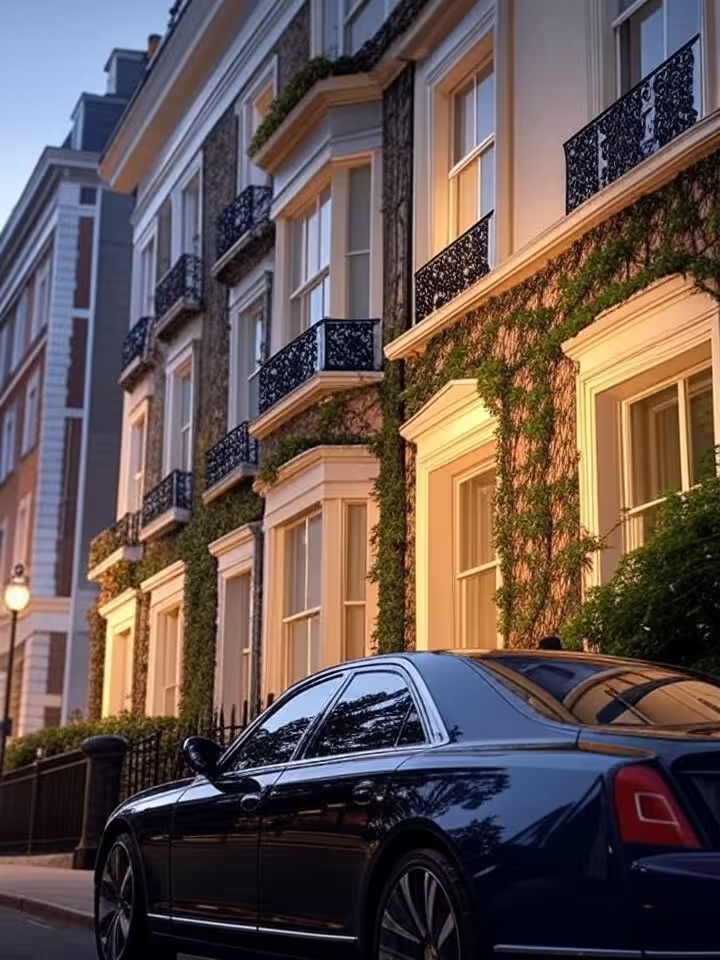
Mayfair: The Silent Theater of Great Fortunes
Walking through Mayfair is like browsing through a Debrett's architectural. From Berkeley Square to Grosvenor Square, each Georgian doorway holds secrets that cab drivers know better than many residents. Here operated Clive from India from his mansion, here Handel composed operas that transformed European taste, and here, every spring, the auction houses move more money in an afternoon than entire national economies move in a month.
But what really defines Mayfair is not its historical credentials, but its ability to reinvent oneself without betraying oneself. That impossible balance between tradition and contemporaneity that only true insiders manage to decipher. Think Mount Street: in the mornings, octogenarian aristocrats breakfast at Scott's, perusing the Financial Times in print; in the evenings, heirs to Asian tech fortunes book tables at Sexy Fish, where the sushi comes with edible gold leaf and no one blinks at a four-figure bill.
The exclusive dating in Mayfair works like their private clubs: it's all in the cross-referencing. It's not uncommon for a chance encounter at Heywood Hill Bookshop - where they still wrap books in brown paper tied with twine - to result in an invitation to a private dinner at Annabel's. But be warned: arriving at Annabel's without the proper introduction is like showing up at Ascot in jeans. Technically possible, socially suicidal.
«True luxury is invisible to those who do not know how to look for it.»
— Alain Ducasse, chef with more Michelin stars than many entire hotels.
What no one tells you about the evenings in these circles is that strategic silence is worth more than brilliant conversation. I have witnessed romances blossom in the National Gallery during private visits at night, where the only illumination were the lamps directed at the Caravaggio, and the only words spoken in half an hour were about chiaroscuro and baroque symbolism. That ability to inhabit shared silence, to communicate through gaze and gesture, separates true connoisseurs from mere tourists of luxury.

The Mistakes That Give A Newcomer Away
I admit to having committed some unforgivable ones in the beginning. Like the time I mentioned prices in a conversation about art at the Gagosian on Davies Street. Or when I arrived on time -on time- to a private dinner, forcing the host to receive me in slippers because it was fifteen minutes before the socially acceptable hour. These circles operate with codes that no social GPS can map:
- Never ask directly what someone does for a livingLet the conversation reveal it naturally, and if it doesn't, you probably don't need to work on it.
- Excessive enthusiasm is suspiciousThe true belonging manifests itself in a certain blasé attitude, as if dining at The Connaught was as routine as buying milk.
- Logos are for touristsSavile Row tailoring without visible labels, heirloom vintage watches, handbags that only other insiders recognize are valued here.
- Culture is social currencyReferences to current exhibitions at the Royal Academy or discussions on Brutalist architecture open more doors than any bank account.
In terms of high level romance, Mayfair offers unique advantages. The meetings here have a intellectual density difficult to replicate. It's not uncommon for a conversation about winemaking in Burgundy to drift into existentialist philosophy, then behavioral economic theory, and end in plans to visit a family winery in Beaune next weekend. That kind of brain chemistry that makes the hours fly by without anyone looking at the clock.
Chelsea: Where the Aristocracy Meets the Bohemian (With Bank Account)
If Mayfair is the establishment with a silk tie, Chelsea is the same establishment but with an unbuttoned collar and a slightly irreverent attitude. Here lived the Rolling Stones in its golden years, here Mary Quant revolutionized fashion from her boutique on the King's Road, and here, still today, you can find that magical balance between centuries-old tradition and unleashed creativity.

The fascinating thing about Chelsea is its cultural stratification. In the same afternoon you can have tea at the Cadogan Hotel - where Oscar Wilde was arrested in 1895, a detail the waiters mention with morose pride - and end up at a conceptual art pop-up in a converted warehouse near Lots Road. That chameleon-like ability to navigate between worlds is precisely what makes the neighborhood so magnetic for sophisticated dating.
The Chelsea Arts Club, founded in 1891, remains the epicenter of that impossible balance. Here, a multi-millionaire art dealer debates with an emerging sculptor about the death of originality in the age of artificial intelligence, while an heir to an oil fortune listens silently, taking mental notes. I've seen romances begin in such conversations, where the intellectual attraction works as a more potent aphrodisiac than any niche perfume.
«Style is a way of saying who you are without having to speak.»
— Rachel Zoe, The stylist who transformed the concept of casual elegance in Los Angeles and beyond.
The Social Rituals That Define the Neighborhood
Chelsea has its own lay sacraments. The Chelsea Flower Show, for example, is not simply a gardening exhibition: it is the social calendar condensed into five days in May. Here, conversations about David Austin roses intermingle with real estate negotiations and first meetings carefully orchestrated by mutual friends. The dress code - which no one writes but everyone complies with - dictates country elegance: think floral dresses without being literal, hats with personality but without excess, shoes that are comfortable but never sporty.
For those looking for memorable first dates, Chelsea offers settings that Mayfair cannot replicate. The **Saatchi Gallery** in Duke of York's Square is perfect for encounters that require substantial conversation without the pressure of a formal dinner. You can wander among contemporary installations, pausing at works that provoke genuine reactions, revealing more about your interlocutor in thirty minutes than in three conventional dinners.
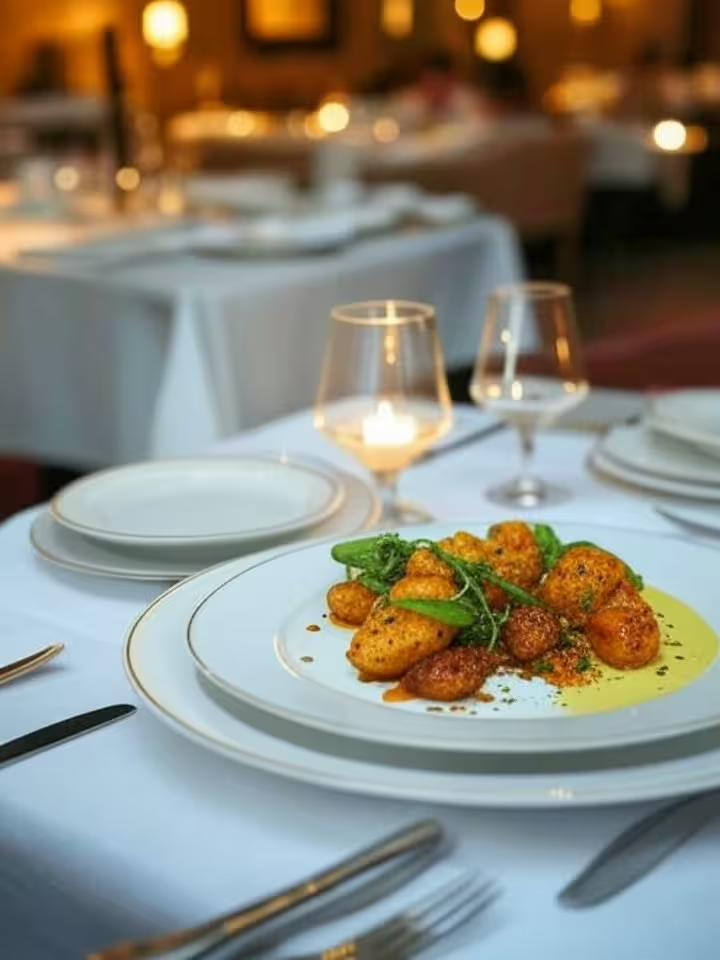
Or consider **Bluebird**, that gastronomic and social temple on the King's Road. It's not the most exclusive restaurant in London - that honor probably belongs to some private club with no public name - but it has something that many ultra-exclusive establishments lost: energy. Here, the scene matters as much as the food. The terrace tables in summer are negotiating territory for all kinds of transactions: business, of course, but also those first romantic gropings where it is not yet clear whether this is professional, social or potentially more.
The Invisible Bridge: Navigating Between Two Social Codes
What makes the high-end London experience unique is precisely this. complementary duality. You can begin an evening at Claridge's bar - with its cocktails served with surgical precision and its art deco atmosphere evoking the golden years of European elegance - discussing emerging markets with someone whose last name appears on corporate buildings. Then a fifteen-minute cab ride takes you to The Surprise, a 17th-century Chelsea pub with 17th-century beams where the same person tells you anecdotes from a safari in Botswana as if he were narrating a trip to the supermarket.
That contextual flexibility is the true mark of the London insider. It's not a matter of choosing between Mayfair or Chelsea, but of mastering both social dialects and knowing when to employ each. I've known heirs who are equally at home at a Sotheby's auction as they are at an indie gig in a Shoreditch basement. That fluidity, that rejection of rigid categories, is what keeps London's social ecosystem alive when other capitals ossify into their own clichés.
Emotional Protocol: The Rules That Nobody Writes
Here's an inconvenient truth that no one mentions in the guidebooks of exclusive datingThe biggest mistake is not to use the wrong cutlery but to show too much interest too soon. These circles value discretion almost as much as wealth. A text message sent exactly three hours after the meeting. A casual invitation that sounds spontaneous but was planned with the precision of a military operation. The ability to hold deep conversations without drifting into premature confessions.
I recognize that this may sound calculated, even cold. And sometimes it is. But there is also a beauty in that dance of gradual approximation, in that building of intimacy that respects individual spaces. As observed by Edith Wharton at The age of innocence, referring to 19th century New York high society but perfectly applicable to London today: «In an age of passions as regimented as theirs, the charm lay precisely in the nuances».
The unwritten rules of London social etiquette include:
- Strategic punctualityarriving exactly on time is almost as bad as being late; the ideal margin is 7-12 minutes after the agreed time.
- The art of tangential conversationNever address important issues directly; let them emerge naturally from seemingly random digressions.
- Deferred gratitude: to thank for an invitation immediately seems desperate; wait for the next day, preferably by handwritten note.
- Cultural knowledge as a social lubricantSubtle references to current exhibitions, theatrical premieres or fashionable intellectual debates facilitate connections without forcing them.
- Selective honestyshares vulnerabilities, but never the deepest ones in the first few encounters; save some for the third or fourth evening.
Sentimental Geography: Places That Matter
Beyond the obvious names, London hides romantic microgeographies that only the initiated know. The walled garden at Mount Street Gardens in Mayfair, for example: a Victorian oasis where tourists rarely enter, perfect for unwitnessed conversations. Or the Chelsea Physic Garden, Britain's second-oldest botanical garden, where among 17th-century medicinal plants you can have the kind of leisurely chat that noisy restaurants make impossible.
For high-level gastronomic events, the choice of restaurant communicates intentions. **Sketch in Mayfair, with its futuristic capsule bathrooms and surreal décor, suggests creativity and a sense of humor. **Gordon Ramsay** in Chelsea conveys culinary seriousness and an appreciation for technical excellence. **Gymkhana**, also in Mayfair, indicates cosmopolitan sophistication and an educated palate beyond European. Every choice is a coded message that your date will instantly decipher.
«Luxury must be comfortable, otherwise it is not luxury.»
— Coco Chanel, who understood better than anyone that true elegance is never uncomfortable.
Also important are the hotels as neutral territories. The bar at the Connaught in Mayfair is perfect for first encounters: formal enough to set high standards, relaxed enough to allow genuine conversations. The Beaumont, also in Mayfair, offers art deco intimacy and a cocktail menu that functions as a liquid personality test: what you order reveals more than you imagine.
The Seasonal Factor: How Seasons Rewrite the Map
One dimension that the conventional guides ignore is how the calendar transforms these neighborhoods. Mayfair in July is partially empty: traditional British families migrate to properties in the countryside or on the coast, making room for an international wave of high net worth visitors. It is the ideal time to meet global entrepreneurs, heirs to Asian or Latin American fortunes, Middle Eastern investors who appreciate London's discretion.
Chelsea, meanwhile, reaches its social peak in spring and early summer. The **Chelsea Flower Show** in May acts as a catalyst, followed by cultural events at the Royal Hospital and private parties in gardens that normally remain hidden behind Georgian walls. September brings another peak, when the London Fashion Week fills the neighborhood with designers, models, magazine editors and that glamorous ecosystem where romance naturally intertwines with professional networking.
Events That Redefine Connections
Beyond the official calendar, there are private events that function as social accelerators. Charity auctions at private mansions in Mayfair, where a generous bid for contemporary art can garner more attention than any profile in exclusive dating applications. Private film screenings in screening rooms that few people know exist. Tasting dinners organized by wine collectors that bring together twelve carefully selected strangers around bottles that cost more than luxury cars.
I have witnessed romances begin at a blind tasting of rare Burgundies in a Belgrave Square townhouse, where the only lighting was candles and the conversation swirled between terroirs, hedonistic philosophy and surprisingly intimate confessions facilitated by the darkness and the 1990 Romanée-Conti. These contexts create accelerated linkagesIn three hours, you know aspects of someone that conventional dating would take months to reveal.
Navigating the Shadows: What Nobody Admits
Let's be honest about the inherent contradictions to these worlds. For every genuine romance that blossoms in Mayfair or Chelsea, there are a dozen emotional transactions disguised as affection. People who collect relationships like those who collect art: not for the love of the object but for the prestige it confers. Encounters where the net worth assessment occurs in the first ten minutes, camouflaged behind seemingly innocent questions about neighborhoods, recent trips or club memberships.
There is also the systematic exclusion that these circles practice without admitting it. It doesn't matter how much money you have if your last name doesn't appear in the Debrett's, if your accent betrays non-aristocratic origins, if your university education does not include Oxbridge. I admit to having seen brilliant, fascinating people, successful on their own merit, treated with glacial cordiality simply because their wealth was first generation.
But here's the nuance that complicates the simple narrative: those barriers are slowly eroding away. The new generation of heirs values global education, cosmopolitan experiences and personal achievements more than simple lineages. I have met dukes' sons fascinated by self-taught tech entrepreneurs, aristocrats who prefer to discuss environmental sustainability rather than their ancestral estates. Change is glacial but real.
Practical Strategies: From Knowledge to Action
If you are planning serious immersion in these ecosystems, a few non-negotiable advice from direct experience:
Investment in closetForget the obvious brands. Look for traditional British tailoring - Anderson & Sheppard, Huntsman - or more accessible but equally elegant alternatives such as Reiss or Hackett. For women, brands like Goat o Emilia Wickstead offer distinctly British elegance without screaming luxury. The rule is simple: if someone can identify the brand at ten yards, it's probably not right for these contexts.
Accelerated cultural education: subscribe to the Financial Times and to the Spectator. Visit exhibitions at the Royal Academy and the National Portrait Gallery before everyone is talking about them. Familiarize yourself with references ranging from Lutyens architecture to molecular cuisine, from British political theory to the global contemporary art circuit. You don't need to be an expert; you need to be able to have informed conversations.
Digital communication protocolsIn these circles, WhatsApp is acceptable but messages should be concise and well written. Unannounced phone calls are invasive. Emails for formal invitations are still valued. And never, ever, use emojis excessively or language that is too casual in the first communications. The communicative elegance matters as much as the face-to-face one.
Management of romantic expectationsThe process here is slower than in conventional contexts. A first date does not guarantee a second one for several days. Relationships develop through spaced encounters, never through time-sharing saturation. And the privacy is sacredWhat happens in these circles is discussed only within them, never in public social networks.
Case Studies: When Theory Meets Life
Let me share three romantic archetypes I have witnessed repeatedly in Mayfair and Chelsea:
The romance of the accidental collectorHe, heir to a European real estate fortune, attends an auction of contemporary photography at Phillips in Berkeley Square. She, an independent art consultant, bids against him for a series by Cindy Sherman. Neither wins the piece, but they exchange cards. Three weeks later, he invites her to see his private collection in his Eaton Square apartment. Six months later, they are planning a joint art foundation. Love came disguised as aesthetic rivalry.
The meeting of the luxury nomadShe, an American architect temporarily working on a restoration project in Mayfair, frequents the Chiltern Firehouse after work. He, a British investment banker with a family home in Chelsea, does the same. They meet repeatedly for weeks without speaking to each other, only exchanging glances and shy smiles. Finally, a mutual friend formally introduces them at a private dinner. Romance was inevitable; it just needed the right social context to manifest itself.
The expanded circle connectionHe meets someone at a technology conference at King's Place. That person invites him to a dinner in Chelsea. There he meets someone else, who includes him in a group trip to a property in Scotland. On that trip he meets her, a college friend of one of the assistants. Nine months later they marry in an intimate ceremony at the Chapel Royal. This pattern - cascading connections through overlapping social circles - is perhaps the most common in these settings.
Final Reflection: Beyond Superficial Glamour
After years of navigating these territories, I have arrived at a paradoxical conclusion: the true luxury of Mayfair and Chelsea does not reside in its Michelin restaurants, its contemporary art galleries or its fifteen million pound townhouses. It lies in something more intangible: the possibility of profound human encounters in contexts that facilitate authenticity.
Yes, there is superficiality. Yes, there are emotional transactions disguised as romance. Yes, economic and social exclusion can be obscene. But there are also moments of genuine connection that these environments, paradoxically, make possible. When two people meet in a Cork Street gallery and spend three hours discussing the relationship between art and mortality without even asking each other their full names. When a conversation about brutalist architecture at the Chelsea Arts Club leads to confessions of shared existential fears. When social protocol acts not as a barrier but as a structure that allows for controlled vulnerability.
As he said Oscar Wilde -argued, ironically, in that same Cadogan Hotel in Chelsea we mentioned earlier- «We can forgive a man for doing something useful as long as we don't admire it. The only excuse for doing something useless is to admire it intensely.» Applied to high-end romance in LondonWe can forgive the transaction as long as we do not forget to admire the human connection that sometimes flourishes despite all social and economic barriers.
Mayfair and Chelsea are, ultimately, settings. Beautiful, historic, loaded with cultural significance. But only settings. The true luxury is what you choose to do in them: you can play the game superficially, collecting encounters like a stamp collector. Or you can use them as contexts that raise your chances of finding someone whose company transforms your understanding of what it means to live well.
The choice, as always in these circles, is yours. But choose with the deliberate grace that these neighborhoods demand. Because that, ultimately, is the only rule that really matters.


 English
  Spanish
  French
  Portuguese
  Italian
  German