
The history of power has always been written around a table. From the Roman banquets where conquests were decided to the Renaissance dinners where families like the Medici weaved commercial alliances, the ritual of sharing food has been the perfect theater for business. Today, in the 21st century, this tradition has not disappeared: it has simply refined its codes. And here comes the uncomfortable truth that no one mentions: in these meals, the winner is not the one who has the best proposal, but the one who masters the invisible choreography of protocol, conversation and presence..
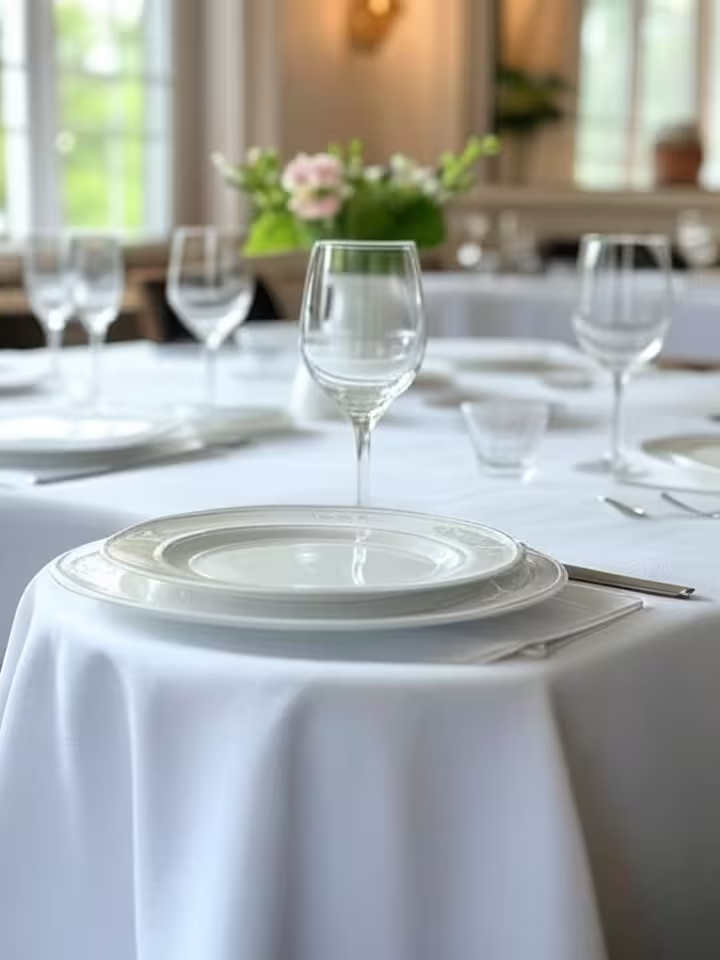
After countless lunches in restaurants where the bill exceeds the monthly salary of many, I have learned that these encounters are multisensory chess games. It's not just about what you say, but how you cut the fish, when you interject into the conversation, and that glint in your eye that conveys confidence without arrogance. The difference between closing a deal or watching it fizzle out can lie in a gesture as miniscule as the exact moment you reach for your glass of wine.
The Art of Arrival: When the First Minute Defines the Next Two Hours
Timing is everything. Arrives exactly five minutes early, no more and no less. Too early suggests anxiety; too late, disrespect. Those five minutes allow you to observe the territory: the type of clientele, the layout of the tables, the level of service. In Paris, in a discreet restaurant near Place Vendôme, I witnessed a textile businessman lose credibility by arriving hot and apologizing profusely. His counterpart - a Japanese distributor - maintained impeccable courtesy, but business never prospered. First impressions are not negotiable.
When you enter, your body language should project quiet confidence. No nervous glances at the table, no nervous table-hopping or abrupt gestures. Walk with purpose, greet with a firm but calibrated handshake-solid enough to convey assurance, sensitive enough to adapt to the other's response. As observed by Coco ChanelElegance is when the inside is as beautiful as the outside«. That balance between form and substance begins in the greeting.
The Wardrobe: Your First Statement of Intent
Here comes something I have verified over and over again: the right clothing is not the most expensive, but the most strategic.. Your outfit should answer three questions: where am I, who am I with, and what result am I looking for? A Savile Row suit is perfect for a banking negotiation in the City of London, but can be stuffy at a tech lunch in Palo Alto, where understated luxury and innovation are expressed in other ways.

Research beforehand is crucial. If your interlocutor comes from the creative sector, incorporate signature design elements-a Jaeger-LeCoultre watch, a vintage brooch, handcrafted Italian shoes. For more conservative environments, moderation is powerAn impeccable suit in neutral tones with a tiny personal detail, such as inherited cufflinks or a Montblanc fountain pen. The subliminal message: «I understand the codes, but I have my own identity».
What absolutely no one warns you about: desperate ostentation is the kiss of death. I saw a tech entrepreneur arrive with an all-too-obvious Patek Philippe Philippe at a lunch with European venture capitalists. His unintended message: «I need external validation.» The result: icy politeness and zero funding. True elegance whispers, never shouts.
The Liturgy of the Cutlery: Where Refinement Meets Strategy
We are now entering technical, but fundamental territory. Cutlery is your navigation map at any formal meal. The basic rule: start with the exteriors and work your way up to the plate with each course. But there are subtleties that make a difference. For example, when pausing between bites, place the silverware at an angle on the plate -never resting on the table-, forming an inverted «V». When finishing, place them diagonally parallel to each other. These visual codes allow the service to read your rhythm without verbal interruptions.
In Milan, during a dinner in the restaurant Da Vittorio, I watched a German automotive executive handle six different cutleries with the precision of a surgeon. His Italian host, known to value cultural detail, closed a strategic alliance that very night. Coincidence? Rarely. Mastery of table etiquette conveys self-discipline, education and adaptability. -exactly the qualities any partner is looking for.
«Good manners open doors that the best education cannot.» - Clarence Thomas, U.S. Supreme Court Justice
But beware: this knowledge must flow naturally. If you hesitate or adopt a mechanical rigidity, the effect is reversed. Practice at home, internalize the movements until they become instinctive. The rules of social protocol are sophisticated body language, not stilted acting.
The Art of Conversation: Building Rapport before Business
Herein lies the most common mistake: launching your commercial proposal before the second course. Business meals are first and foremost confidence-building exercises.. The transaction is the natural outcome of a well-knit human connection, not the starting point.
It begins with neutral but revealing territory: cultural references, travel experiences, observations on industry trends-always from genuine curiosity, never as an exhibitionist monologue-«I read that you were at the Venice Biennale, which pavilion struck you the most?» or «Your company just expanded to Singapore, fascinating time for Southeast Asia.» These openings demonstrate that you have done your homework and that you see your interlocutor as a person, not as a transaction..
Active listening is your superpower. Maintain eye contact, subtly nod, rephrase key ideas to confirm understanding: «If I understand correctly, your priority is to consolidate rather than grow...» This conversational mirroring creates neurological attunement. As a communication strategist, I've found that people remember more of what they're saying. how you made them feel than the concrete data you presented. Take advantage of it.
Safe and Dangerous Conversational Domains
Secure land:
- Contemporary art and culture (exhibitions, architectural trends, latest museum acquisitions)
- Unique destinations and transformative travel experiences
- Sectoral innovations and industry evolution
- Sophisticated gastronomy and enologyknow the basics about wine is an investment that pays social dividends
- Strategic philanthropy and corporate responsibility
Minefield:
- Partisan politics -even when you think you share ideology
- Religion or polarizing moral positions
- Corporate gossip or personal criticism of third parties
- Personal financial matters (your salary, your investments)
- Complaints about competitors -doubt of insecurity
In London, during a dinner at Sketch, I witnessed how a casual comment about Brexit turned a promising negotiation into diplomatic ice. The lesson: when in doubt, abstain. There are a thousand fascinating topics that do not involve ideological minefields.

Alcohol: The Ultimate Test of Self-Control
Let's be brutally honest: alcohol at business meals is simultaneously social lubricant and potential dynamite. The golden rule that never fails: limit yourself to two drinks, spaced and sipped, never drunk. If you're a host, your first responsibility is to make sure everyone is comfortable-which includes respecting if someone doesn't drink and never pressuring.
I have closed significant deals precisely because I maintained mental clarity while my counterpart became excessively relaxed and revealed strategic information. This is not manipulation, it is professionalism. As observed by Ernest HemingwayAlways do sober what you said you would do drunk. That will teach you to keep your mouth shut«. In negotiation contexts, this wisdom is literal.
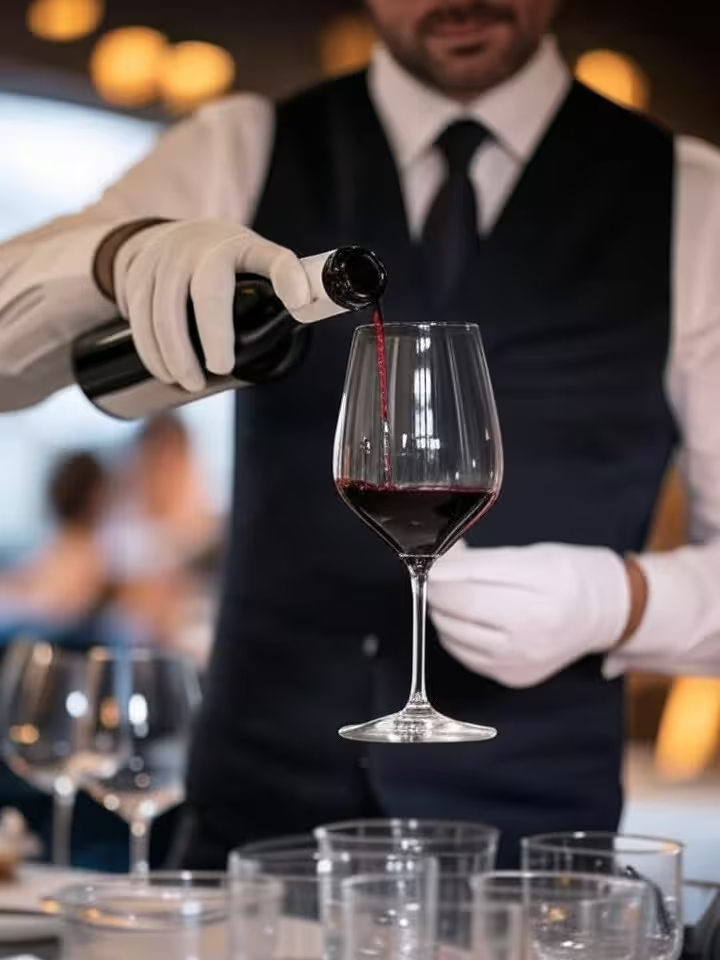
If you are offered an exceptional wine -say, a Château Margaux of legendary vintage-, appreciate generosity, taste with knowledge, but keep in moderation. A polite comment on tasting notes («fascinating tannic complexity») shows sophistication; emptying your glass in three gulps, quite the opposite.
The Subtle Transition: From Rapport to Agreement
There is a magic moment in every successful business lunch: that moment when the conversation flows naturally from the personal to the professional. Don't force it, but don't lose it either.. The signs are subtle: your interlocutor leans slightly forward, the pace of the conversation quickens, more specific questions about your industry appear.
The elegant transition uses conversational bridges: «You mentioned your interest in sustainability, and right there it connects with what we are developing...» or «That logistical challenge you describe is exactly where our technology brings differential value». You link their world with your proposal, making the business seem like a natural consequence of the dialogue, not an abrupt interruption.
Here the sophisticated conversation strategyYou present ideas without commercial aggressiveness, you raise possibilities without pushing for immediate decisions, and - crucially - you leave room for them to reach favorable conclusions on their own. As I said Peter Drucker, The father of modern management: «The most important communication is to listen to what is not said».
Cultural Codes: When Geography Rewrites the Rules
The globalization of luxury does not imply homogenization of protocols. Cultural nuances can make a gesture that is perfectly appropriate in Paris offensive in Tokyo.. Some verified examples:
East Asia (China, Japan, Korea): Hierarchy is sacred. Wait for the senior person to sit down first, begin eating, and lead the topics of conversation. Silence is respected, not awkward. Never stick chopsticks vertically into the rice-it is funerary symbolism. Business cards are given and received with both hands, like precious objects.
Middle East: Hospitality is the supreme honor. Refusing initial food or drink may be interpreted as a slight. Eat with the right hand only - the left hand is considered impure. Negotiations require extreme patience; haste denotes disrespect for the relational process.
Mediterranean Europe: Personal warmth accelerates business. A lunch can be extended for three hours without meaning inefficiency, but rather building trust. Expressing moderate emotions is acceptable; Nordic coldness can be interpreted as disinterest.
North America: Efficiency and openness are values. Meals are shorter and results-oriented. «Let's cut to the chase» is not rudeness, but appreciated cultural pragmatism.
A Swiss hotel CEO shared his rule with me: «Research at least three specific cultural details before any international meal. That minimal effort prevents disasters and conveys intelligent respect.
When Things Go Wrong: Recovery with Grace
Perfection is fiction. At some point you will make a protocol error, misunderstand a cultural signal, or simply say something that falls flat. Mastery does not lie in impeccability, but in elegant recovery..
If you mess up, immediately acknowledge it naturally: «Sorry, that sounded different from my intention» or «I wasn't familiar with that detail, thanks for the clarification». Genuine humility disarms tensions and, paradoxically, increase your credibility -demonstrates sufficient confidence to admit fallibility-.
I experienced this personally at a dinner in Munich, where I mistook a sensitive German historical reference. The silence was stony. Instead of justifying myself, I simply said, «That was an ignorant remark on my part. I would love to learn the correct perspective.» The conversation not only recovered; my host shared family stories that cemented a lasting relationship. Calibrated vulnerability is strength.
The End: When Farewell Defines Follow-Up
The closing of a business meal requires as much attention as the opening. Never leave in a hurry, as if you had a more important emergency. This invalidates the previous two hours. Also, don't go on forever with forced table talk when the meeting is clearly over.
If you are a host, handle the bill with absolute discretion-no dramatic scrutiny or comments about prices. Give your card to the waiter in advance if possible, so that the transaction is invisible. If you are a guest and are offered to pay, accept with simple gratitude: «That's very generous of you, thank you.» Insisting on splitting when you were clearly invited denotes cultural awkwardness.
When you say goodbye, offer a concluding handshake and a memorable but authentic phrase: «It's been genuinely enriching» or «I hope this is the start of something valuable for both of us. Avoid empty clichés like »We'll be in touch«-better be specific: »I'll send you that information on Tuesday.
And here comes the detail that separates professionals from amateurs: personalized follow-up within 24 hours. Not a generic thank you email, but a message that references something specific from the conversation: «I remembered your comment about expansion in Dubai. Here is an article from Financial Times you might be interested in. That shows real attention and maintains momentum.
The Hidden Dimension: When Business Meets Romance
Let's face it: in certain unique contexts, the lines between professional networking, high-level dating and strategic opportunities become blurred. Especially in creative, luxury and lifestyle sectors, where personal and professional relationships are organically intertwined.
If you sense personal chemistry during a theoretically business meal, Maintain impeccable professionalism during the meeting.. Any exploration of personal dimensions should occur later, in clearly differentiated contexts. Mixing signals during the initial meeting creates confusion about intentions and can sabotage both the romantic and professional opportunity.
The golden rule: clarity of purpose. If the meal is business, keep it there. If legitimate personal interest arises, acknowledge it later with elegant candor: «I enjoyed our conversation beyond the professional. I'd love to continue in a different context.» This honest separation protects both possibilities rather than contaminating each other.
Real Scenarios: Lessons from the Trenches
Let me share three situations that crystallize these principles:
Case 1: The Monte Carlo yacht lunch
A Latin American real estate entrepreneur invited potential European investors to his yacht anchored in Port Hercules. The setting was spectacular, the menu impeccable, but he made a fatal mistake: he turned the meal into a continuous business presentation. He talked non-stop about projects, figures, returns. His guests maintained frosty politeness and subsequently declined. Lesson: The luxury of the stage does not compensate for the conversational poverty. Should have built human connection first.
Case 2: The tech dinner in Palo Alto
A startup founder met with a legendary Silicon Valley investor at an unpretentious restaurant. She wore appropriately casual but polished attire, listened more than she talked, and when she presented her vision, she did so as passionate narrative, not robotic pitch. He got Series A funding. LessonAdapting form to context without sacrificing substance distinguishes those who understand that protocol is a tool, not a straitjacket.
Case 3: The disaster in Shanghai
A Western executive arrived at a crucial meal with Chinese distributors and began eating immediately, without waiting for the hosts. He spoke about business before the second course was served, interrupted frequently, and politely declined toasts of ganbei (drinking to the bottom) citing moderation. The association was cancelled. Lesson: Ignoring specific cultural codes conveys unforgivable arrogance, no matter how solid your business proposition is.
The Final Truth: It's All Conscious Theater
After decades of navigating these rituals, I have come to a conclusion: business meals are collaborative theater where both parties act knowing the rules. It is not hypocrisy; it is sophistication. Just as a ballet dancer makes extreme effort seem like natural grace, the mature professional masters these codes until they become second nature.
The paradox of the protocol is that the more you internalize it, the more authentic you can be. When you're not worried about which fork to use or how to sit, your attention is freed to genuinely connect. It's like mastering a foreign language: first you struggle with grammar, eventually you think directly in that language.
As he wrote Ralph Waldo EmersonLife is a journey, not a destination. These meals are micro-universes of that truth. The specific deal matters, yes, but the network of relationships you build meal after meal-that's your real professional fortune.
So the next time you book that table at a restaurant where diners whisper and glassware glows in the dim light, remember: you're not just having lunch. You're performing an ancient dance of power, culture and human connection. Master the steps, but never forget that real music comes from the authenticity with which you perform each movement.
Because in the end, in the world of luxury and high-end business, people will forget the numbers you presented and the technical details of your proposal. But they will never forget how you made them feel during those two hours shared. And that, more than any contract, is what opens the doors that really matter.


 English
  Spanish
  French
  Portuguese
  Italian
  German