
Coco Chanel put it bluntly: «There is no second chance for a first impression.». And in luxury circles, that first impression is often condensed into a gesture that lasts less than three seconds: the handshake. I've witnessed how a miscalibrated handshake at a Christie's charity gala buried months of networking, and how a perfectly executed kiss on the cheek opened the doors to a private circle of investors in Geneva. What most people don't know is that greeting in exclusive contexts is not automatic politeness, but a social choreography that speaks of your education, your travels, your experience and, above all, your ability to read the room..

The Greeting as an Access Code: The Anthropology of First Contact
From the proskynesis Persian (that greeting with reverence before the nobility) until the hongi Maori (the brushing of noses symbolizing the exchange of vital breath), each culture has developed protocols of initial contact that reveal hierarchies, respect and belonging. In the contemporary world of luxury, these traditions merge in spaces where a Saudi prince, a Parisian heiress and a Silicon Valley tech mogul share the same table. The truly privileged person is not the one who knows one form of greeting, but the one who masters the art of alternating between them without losing authenticity..
During a private event at the Hôtel du Cap-Eden-Roc, I watched as a Latin American businessman greeted a British duchess, who was clearly expecting a handshake, with two kisses. The silence that followed was deafening. It is not a matter of one form being superior to another, but rather that each context requires its own body grammar, and not knowing it instantly makes you an outsider, no matter how thick your wallet is.

The Physics of the Handshake: Firmness, Duration and Emotional Temperature
Winston Churchill claimed that he could judge a man's character by his handshake. Exaggerated, perhaps, but not without truth. In high-level professional contexts-from a meeting at Soho House to an introduction at the World Economic Forum in Davos-the handshake remains the gold standard. But there is a hidden art to those three seconds of palm-to-palm contact.
Firmness should communicate security without dominance. A dead-fish squeeze suggests insecurity or disinterest; a bone-crushing one speaks of overcompensating insecurity. The sweet spot is a steady squeeze that matches the other's, lasting two to three seconds, accompanied by direct but non-challenging eye contact. What no one tells you is that the temperature of your hand matterscold hands can be perceived as distant or nervous, while excessively clammy hands betray anxiety. I always carry a discreet handkerchief and, before entering important events, I make sure my hands are dry and at room temperature.
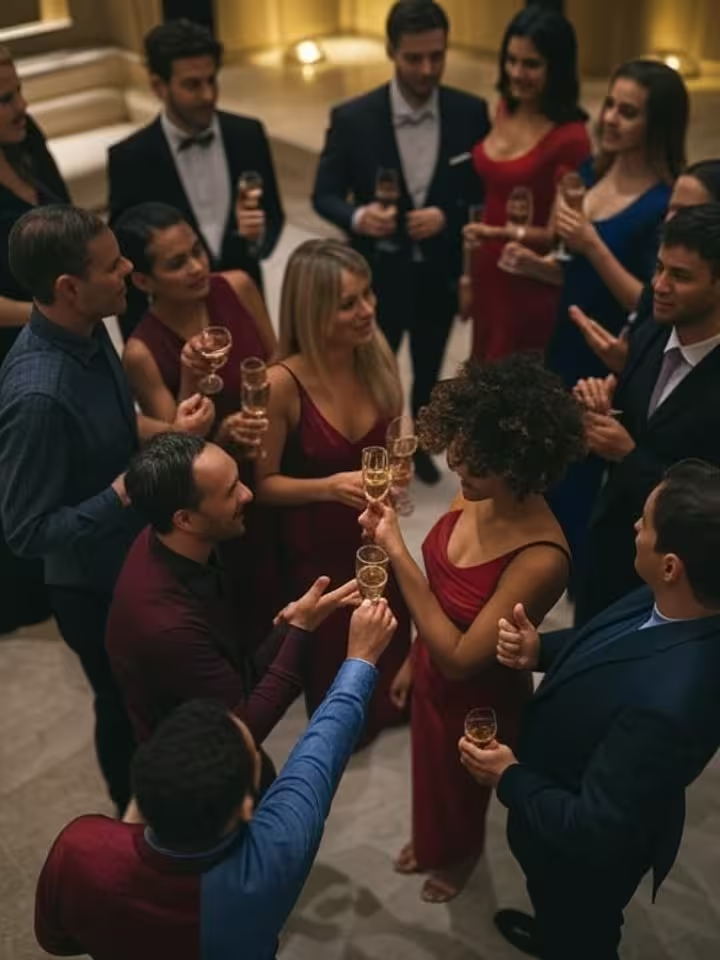
Squeeze Variables in Different Contexts
- In exclusive corporate events: Firm, brief, vertical. Never cover each other's hand with your second hand (the «politician's handshake») unless there is prior trust.
- In luxury social presentations: Slightly softer, with a genuine smile. Warmth balances formality.
- With authority figures or advanced age: Respect their initiative. If they extend their hand first, respond equally but without exceeding their intensity.
- At exclusive dating contexts: The handshake may work on first formal encounters, but the transition to a kiss on the cheek or light hug should occur naturally on subsequent dates.
The Kiss on the Cheek: Geography, Gender and Gradation of Intimacy
This is where things get deliciously complicated. Social kissing varies dramatically according to geography, gender and degree of familiarity. In Paris, two kisses are the norm between acquaintances, but in certain aristocratic circles, four kisses mark membership in a specific inner circle. In Madrid and Buenos Aires, one kiss is usually enough, but at high-profile events, two is safe. In London, kissing is less common in formal settings; better to wait for clear signals.

During a jewelry launch at Place Vendôme, I witnessed an American designer kiss one cheek to a French editor, who was clearly expecting the second. The mismatch was minimal, but noticeable. The unwritten rule: when in doubt, follow the initiative of the venue or host.. And always, always, the contact is cheek to cheek, never lips to skin (unless it is close family or partner).
«Elegance is when the inside is as beautiful as the outside.» - Coco Chanel
This maxim applies perfectly to the greeting: the outward form should reflect a genuine intention to connect, not just fulfill an empty ritual.

Greeting Protocols in Different Luxury Ecosystems
In High-end Gastronomic Events
The dinners at Michelin-starred restaurants have their own code. If you arrive first at an appointment, get up when the other person arrives. The greeting should be warm but restrained - this is a gastronomic temple, not an Ibiza nightclub. A kiss on the cheek or a handshake followed by «nice to see you» sets the perfect tone. Never greet the chef effusively if he passes by your table.; A respectful nod and a discreet «extraordinary» is enough. Ostentation here is vulgarity.
In Elite Ski Destinations
In places such as St. Moritz or Courchevel, après-ski mixes sporty informality with casual luxury. Here, a light hug followed by pats on the shoulder works perfectly between men, while with women, kissing on both cheeks is standard. What's interesting is that the sports context authorizes greater physical warmth without crossing boundaries of familiarity. I've noticed that in these settings, authenticity trumps rigid protocol: if you genuinely enjoy someone's company, a «It's good to see you here!» with real energy is worth a thousand measured bows.
In Mediterranean Yachts and Beach Clubs
The exclusive beach clubs in the Mediterranean (Nikki Beach in Saint-Tropez, Nammos in Mykonos, Cavalli Club in Porto Cervo) operate under «casual luxury» rules. Here, excessive formality marks you as a novice. Greetings are relaxed: a hug with two kisses is common, even in first meetings if the atmosphere is festive. But beware: this informality has invisible limits. Never assume excessive intimacy with someone you have just met, no matter how relaxed the dress code.
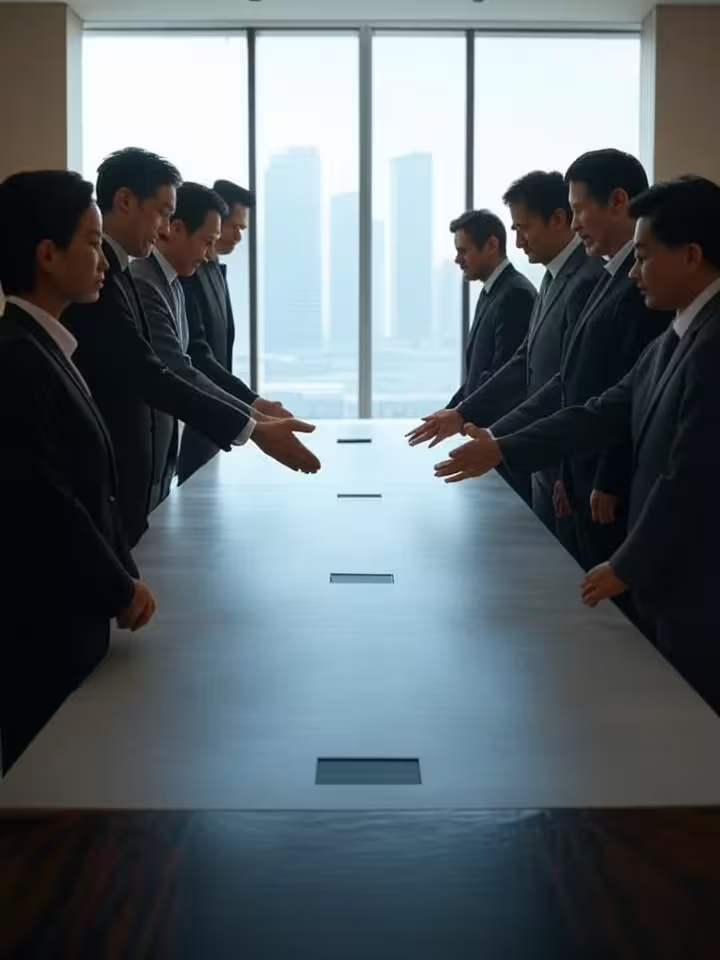
The Cultural Dimension: Navigating Global Greetings Without Losing Your Essence
In Dubai, the traditional greeting «as-salaam alaikum» (peace be upon you) followed by the response «wa alaikum salaam» shows deep cultural respect. But never try to kiss an Emirati woman if you are a man.; protocol dictates waiting for her to extend her hand first, and if she doesn't, a slight nod of the head is enough. In my years navigating these circles, I've learned that international diplomatic protocol provides a solid foundation for these multicultural contexts.
In Japan, the bow (ojigi) has three levels: 15 degrees for casual acquaintance, 30 for standard respect, 45 for maximum respect or apology. In upscale international business contexts in Tokyo, a hybrid works well: slight head tilt (15 degrees) followed by handshake, recognizing both traditions without exaggerating either.
Cultural Mistakes that cost dearly
- Touching someone's head in Thailand: Considered the most sacred part of the body, touching it is a serious offense.
- Using the left hand to greet in Arab countries or India: Reserved for personal hygiene, it is considered impure.
- Premature hugging or kissing in Nordic cultures: Swedes, Finns and Norwegians value personal space highly.
- Refusing a traditional greeting for «western comfort»: In elite global circles, cultural adaptability is a sign of genuine sophistication.
The Luxury Dating Greeting: Seduction, Timing and Gradual Escalation
As Oscar Wilde wrote, «The best way to appreciate your work is to imagine yourself without it.». To paraphrase: the best way to perfect your romantic greeting is to imagine yourself ruining it completely. At first luxury appointments, The greeting is your emotional opening, and as in chess, mediocre openings doom the whole game.
First appointment: Opt for the elegant middle ground. If it's a formal meeting (dinner, opera, gallery), a kiss on the cheek preceded by «it's nice to finally meet you» works. If it's a casual-chic encounter (brunch, stroll through the Retiro, drink on a terrace), a light embrace with hands on shoulders, brief but warm. The critical thing: read their body language when approaching. If he leans slightly toward you, go ahead; if he maintains body distance, stay in the handshake with a genuine smile.
Second or third appointment: Here the escalation should be perceptible. A longer embrace, perhaps with a hand on the lower back, communicates progression of intimacy without invading. The farewell greeting is as important as the welcome greeting.A «I had a wonderful time» followed by a kiss on both cheeks (or one closer to the corner of the lips, if the chemistry is evident) leaves a lasting impression.
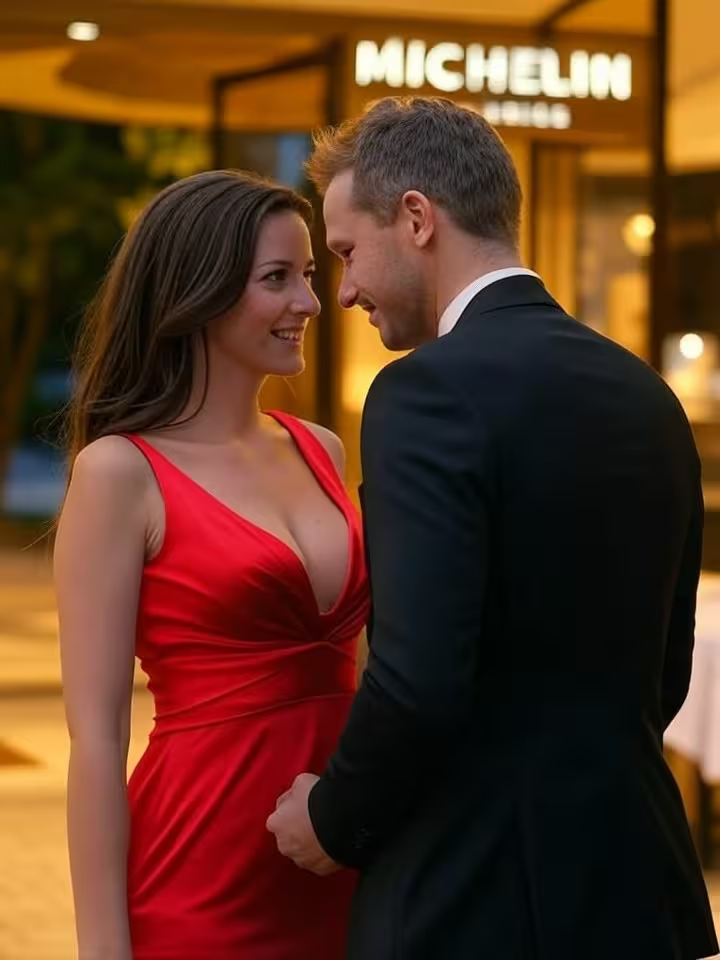
Special Cases in Exclusive Dating
Public vs. private meetings: If you coincide in a social event with friends or acquaintances, the greeting should be calibrated for the audience present. An affectionate hug is fine; a passionate kiss is not. Discretion is the uniform of the truly privileged. Remember that in elite circles, the privacy of relationships is valued as highly as Beluga caviar.
After physical intimacy: Once that boundary is crossed, the greeting evolves naturally. But even here there are codes: in formal public settings, maintain composure; in private, warmth can increase exponentially. The key is emotional consistency: your greeting should reflect the real status of the relationship, not one-sided aspirations.
Specific Protocols: Titles, Hierarchies and Forms of Treatment
Lord Byron (the poet, not just the title) said that «society is now a polished masquerade where everyone looks the same.». In contexts where titles of nobility, diplomatic positions or corporate hierarchies come into play, ignoring the correct forms of treatment is not democracy, it is ignorance..
If you are introduced to someone with a noble title (Duke, Count, Baroness), the correct greeting includes the title: «Pleased to meet you, Duke» or «A pleasure, Lady Hamilton». Never use the first name until explicitly authorized to do so.. With diplomats, «Ambassador» or «Excellency» are appropriate. With Fortune 500 CEOs, «Mr. Martinez» until it suggests informality.
One mistake I have witnessed repeatedly: at a private dinner hosted by an auction house, a new collector called a Saudi prince «friend» in the first exchange. The prince was polite, but the conversation died there. Forced familiarity is the enemy of true connection.
Parallel Body Language: What Your Body Is Saying While Your Mouth Is Saying Hello
The anthropologist Paul Ekman, expert in microexpressions, demonstrated that 55% of the communication is nonverbal. Your verbal greeting may be impeccable, but if your body communicates something else, the message is contaminated.
- Visual contact: Direct but warm, not intimidating. Duration: three seconds during the greeting, then natural.
- Smile: It must reach the eyes (Duchenne smile). A smile only from the mouth is perceived as false.
- Posture: Shoulders back, but relaxed. Stiffness communicates nervousness; reluctance, contempt.
- Distance: In Latin and Mediterranean cultures, 50-80 cm. In Anglo-Saxon and Nordic cultures, 80-120 cm.
- Body orientation: Turn completely toward the person. Waving in profile while looking away is a subtle insult.
Complex Situations: When Protocol Comes into Conflict
What To Do When You Don't Remember Meeting Someone?
It happens at large events. The person approaches you effusively, clearly expecting you to recognize them. Elegant honesty saves: «Excuse me, tonight has been a whirlwind of fascinating faces. Remind me where we met, please.» Never feign recognition; it shows, and is more offensive than sincere admission.
When Someone Ignores You or Rejects Your Greeting
It could be distraction, rudeness, or they just didn't recognize you. Do not insist. A second attempt makes you look desperate. If it's genuinely important to your networking, wait for a better opportunity later. And if it was deliberate rejection, your dignity is worth more than any connection. I have seen insecure millionaires chasing rejected greetings; desperation is repellent in any bank account.
Greetings in Pandemic and Post-Pandemic
COVID-19 altered physical contact protocols, and some modifications persist. The «elbow bump» had its moment, but in luxury circles, it has given way to a hybrid: slight nod accompanied by «it's good to see you» works when there is doubt about physical contact. The post-pandemic golden rule: observe and mirror each other's initiative. If they reach out, respond; if they prefer distance, respect.
Deliberate Practice: Perfecting Your Greetings Repertoire
As in the domain of languages for international circles, The perfect greeting requires conscious practice. It is not a matter of memorizing rules, but rather of develop naturally flowing social intuition.
Practical exercises:
- Record your greetings: In video calls or with friends, record how you say hello. Check body language, timing, smile authenticity.
- Observe the teachers: At exclusive events, identify who greets most gracefully and study subtleties. The best make the complicated look easy.
- Practice adaptability: Before international events, research specific cultural protocols. Five minutes of research will prevent years of embarrassment.
- Cultivate presence: Meditation and mindfulness enhance your ability to be genuinely present during greetings, not on autopilot.
Greeting as Philosophy: Beyond the Mechanical Gesture
Maya Angelou put it perfectly: «People will forget what you said, they will forget what you did, but they will never forget how you made them feel.». An exceptional greeting makes the other person feel seen, valued and important.. It is not an empty technique, but an expression of a philosophy of genuine respect.
In my years of navigating high-profile events, from galas at the MET to private dinners in Tuscan villas, I have concluded that memorable greetings share three invisible qualities: authenticity, presence and adaptability.. You can master every rule of protocol, but if you say hello with no real human connection, you're just a well-programmed robot.
The true elegance in the greeting is not in executing the correct form, but in make the other person feel that, for those three seconds, he or she is the most important person in the room. And that, believe me, is not taught in etiquette manuals; it is cultivated with awareness, experience and, above all, with the humility to recognize that every human encounter, no matter how brief, deserves your best version.
So the next time you extend your hand, bow your head, or kiss a cheek, remember: you are not fulfilling an empty social ritual. You are writing the first paragraph of a story that can end in indifference or memorable connection. And in the world of authentic luxury, that difference is everything.


 English
  Spanish
  French
  Portuguese
  Italian
  German