
In 1965, Diana Vreeland - the legendary publisher of Vogue- uttered an uncomfortable truth to a room full of aspiring fashion editors: «Style is all your own. Protocol, on the other hand, is the secret language of those who have already arrived.» And she was right. For while style can be bought, protocol is learned in the trenches of private salons, diplomatic receptions and yachts moored at Port Hercules.
Today I'm going to tell you something that few publications dare to admit: there are four types of protocol that govern global power circles, and each has its own rules, its own silent codes and, above all, its own consequences when you ignore them. It is not aristocratic rigidity or empty formalism; it is the art of moving fluidly between worlds that operate with different languages.

Social Protocol: The Invisible Dance of Careful Appearances
Social protocol is the most democratic of the four, but also the most treacherous. Because there is no written manual hereis pure observation, cultivated intuition and that almost telepathic ability to read a room in three seconds.
Think of a wedding in the vineyards of Napa Valley. You arrive fifteen minutes after the official time-never the first, never the last. You greet with a kiss on the right cheek in New York, two alternating kisses in Paris, a light embrace in Buenos Aires. You keep your champagne glass in your left hand so that your right hand is always ready, you never monopolize the groom, and of course, you never mention the price of your gift.
What no one tells you is this: true social etiquette is based on strategic generosity. You listen twice as much as you talk. You ask questions that reveal genuine interest without seeming inquisitive. And when you spot that awkward moment-someone spilling wine, a political comment out of place-you act as if nothing happened.
I remember a dinner at the Hôtel de Crillon in Paris where a tech entrepreneur new to these circles made the classic mistake: he began reciting his business accomplishments before the second course. The host - an art collector with connections that reached all the way to the Elysée - simply redirected the conversation to the latest Basquiat exhibition at the Louis Vuitton Foundation. The message was clear without the need for words: here we celebrate taste, not net worth.
«True social elegance is making others feel comfortable, even when you're not.».
— Elsie de Wolfe, pioneer of interior design and New York high society figure
But here comes the honest part: social etiquette can also be a mask. I have seen superficial relationships dressed up as politeness, hollow conversations disguised as wit. The key is to find that balance between following form and maintaining authenticity. As our analysis of how to communicate with genuine elegance, It's not about acting, it's about refining who you already are.
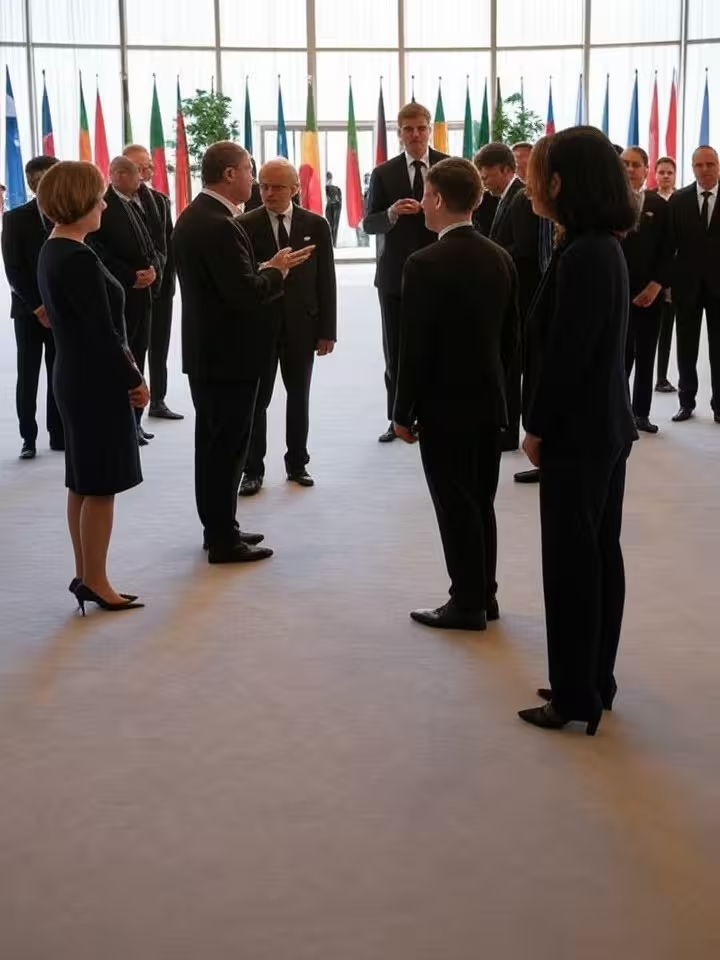
Business Protocol: Where Power Gets Dressed as Courtesy
If social protocol is a waltz, business protocol is a tango: more intense, more calculated, with real financial consequences. Here we enter territories where every gesture is a silent negotiation.
Imagine a meeting at the offices of Goldman Sachs in Hong Kong. The handshake should be firm but not aggressive -two seconds, direct eye contact-. In Japan, you hand over your card with both hands, slight bow, and receive it as if it were a sacred object. You never put it away immediately; you place it on the table in front of you for the entire meeting. In Dubai, never use your left hand to deliver documents. In Stockholm, punctuality is not politeness, it is contractual respect.
But here's the fascinating thing: business protocol changes dramatically after 6:00 p.m.. Real deals are not struck in conference rooms with PowerPoints; they are forged at private dinners at the Ristorante Cracco of Milan, in the pits of the Annabel's in Mayfair, on terraces overlooking the Bosphorus where the raki flows and the ties loosen.
A CEO of a private equity firm confided to me years ago in Singapore something revealing: «The formal protocol is the audition. The informal dinner is where we decide if we really want to do business with you.» Because in those moments, what they are evaluating is not your pitch deck, but your ability to have an intelligent conversation about contemporary art, natural wine or sustainable architecture..
Data that matters:
- In Asian cultures, the prolonged silence is not uncomfortable; it is a space for reflection that demonstrates seriousness.
- In Nordic negotiations, The apparent informality hides very high expectations of preparation and punctuality.
- In Anglo-Saxon environments, before going into the subject, the small talk is not filler; it is an evaluation of character.
- In Latin American circles, establishing personal rather than professional connections is not a waste of time; it is a strategic investment.
What few people understand is that luxury business etiquette incorporates elements of social etiquette in surprising ways. That's why mastering the unwritten rules of the elite positions you better than any MBA from an ivy league university.
Diplomatic Protocol: The Ballet Choreographed Through Centuries of History
Here we enter sacred ground, where every centimeter of distance, every second of timing, every syllable uttered has been calibrated by international treaties and centuries of precedent. Diplomatic protocol is the invisible architecture that sustains relations between nations., but also the code that governs certain elite events where political power intersects with economic power.
Think of a reception at the Palais des Nations in Geneva. The order of entry strictly follows the seniority of diplomatic relations. Ambassadors are announced by full title. Talks avoid sensitive bilateral issues in public spaces. Even the buffet layout is designed to facilitate «casual» meetings between delegations that are not officially negotiating.
I have attended galas where ministers from countries technically in conflict shared a table, maintaining an icy courtesy that could be cut with a knife. Diplomatic protocol works as a shield against emotional chaos, allowing the reason of state to prevail over personal antipathies.
Details that make a difference:
- Actual precedenceHeads of State always have priority over heads of government, who have priority over ministers.
- Flags and anthemsTheir order and treatment are regulated by specific protocols; they are never decorative.
- Titles and treatmentsAddressing someone as «Your Excellency» when «Your Highness» is not a minor error; it is a diplomatic insult.
- Official giftsThey must be culturally appropriate, of symbolic rather than monetary value, and never personal.
But here comes the part that few sources admit: diplomatic protocol, however rigorous it may be, is also evolving.. When Emmanuel Macron broke certain formalities in his first meetings with Donald Trump, it was not clumsiness; it was calculated strategy. When Jacinda Ardern appeared with her baby at the UN General Assembly, she subtly redefined the boundaries of what was protocolally acceptable.
«Diplomacy is the art of letting the other guy get away with it.».
— Daniele Varè, Italian diplomat and writerlockquote>
If you move in circles where the political and the business intersect -think tanks, international economic forums, corporate dinners, etc.-, you can be a good candidate to be a member of the Trilateral Commission—, mastering this protocol makes you a respected insider. Because you will know when to bow, when to offer precedence, when to keep diplomatic silence.
Royal Protocol: The Last Bastion of Aristocratic Etiquette
And finally we reach the Everest of protocol: the rules governing interaction with real houses. This is the territory where history outweighs fortune, where an inherited title trumps any zero in a bank account.
If you ever find yourself in an audience with royalty - be it at Buckingham Palace, the Royal Palace in Madrid, or on the yacht Pacha of the royal family of Monaco - these are the unbreakable rules:
For ladiescurtsy (bow) on meeting and parting. Depth depends on rank: deeper for monarchs, lighter for lesser titles. For Gentlemenbow from the neck, never from the waist as in Asia. For allNever turn your back when leaving; walk backwards a few steps before turning around. Speak only when addressed. Use «Your Majesty» on first reference, «Madam/Sir» afterwards.
But what's fascinating about contemporary royal protocol is how it is being subtly modernized without losing its essence.. See how Queen Letizia of Spain has introduced elements of accessibility, how the Danish royal family balances Nordic informality with monarchical dignity, how Princess Charlene of Monaco fuses her athletic past with her aristocratic duties.
A telling anecdote: at a royal banquet I attended years ago, an American businessman made the mistake of patting the back of a duke. The silence that followed was deafening. No one said anything, but then again, they didn't need to. In real protocol, transgressions are punished with silent exclusion, not public reprimands..
What no one tells you is that royal protocol also has its informal codes. At house parties in British aristocratic estates, the rules relax but do not disappear. At private receptions for the Grimaldi family in Monaco, etiquette is softened but the hierarchy remains. As we explored in our guide to the art of receiving with elegance, Even in relaxed contexts, form matters.
«The protocol exists so that the authority does not have to demonstrate its power; it is already implicit in the forms.».
— Sir Harold Nicolson, British diplomat and writerThe Intersection: When the Four Protocols Meet
Now, here's what's really interesting: the four protocols do not exist in separate silos. In elite global circles, they are constantly intertwined, creating situations of fascinating complexity.
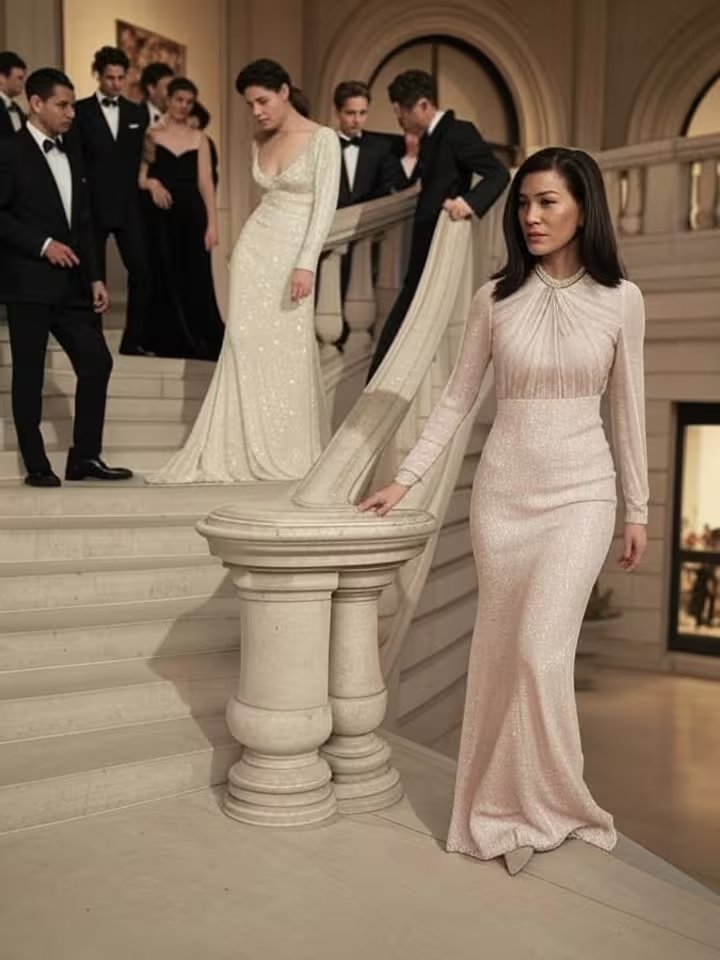
Imagine a gala benefit at the Metropolitan Museum of New York. In attendance are members of European royal houses (royal protocol), ambassadors from economic powers (diplomatic protocol), fortune 500 CEOs (corporate protocol), and New York high society figures (social protocol). How do you navigate this multilayered maze?
The answer lies in what I call «contextual hierarchy»The dominant etiquette depends on the main context of the event. At that Met gala, social protocol predominates because it is fundamentally a cultural-social event, but you must be prepared to activate the other three when the situation calls for it.
This also applies to the world of high-level dating. When you meet someone in a Michelin-starred restaurant, You are combining social etiquette with business niceties (because every elite meeting is also networking). If your appointment has diplomatic or aristocratic connections, elements of those protocols also come into play.
A revealing fact about the Telegraph Luxury points out that 73% of senior executives consider mastering multiple protocols more valuable than speaking several languages. Because while language translates words, protocol translates intentions, power and belonging.
The Hidden Codes: What Protocol Reveals About Power
But let's be honest for a moment. The protocol is also a tool for exclusion. Each of these four systems creates invisible but effective barriers that separate those who «belong» from those who do not.
When someone doesn't know to wait for the hostess to pick up her fork before starting to eat (social protocol), or hands over her business card with one hand in Japan (business protocol), or sits down before an ambassador (diplomatic protocol), or touches a royal without permission (royal protocol), those transgressions function as instant outsider markers.
Is this fair? Probably not. Is it the reality of how these worlds operate? Absolutely yes.
The good news is that these codes can be learned. You don't need to be born in Kensington Palace or have studied at Eton to master them. What you do need is keen observation, a willingness to learn and, above all, the humility to recognize when you don't know something.
As well documented by Debrett's, the British authority on etiquette since 1769, «true refinement is not in blindly following rules, but in understanding them well enough to know when they can be relaxed.».
Protocol In The Digital Age: New Rules For Old Games
And then there is the inevitable question: how do these centuries-old protocols adapt to our age of Instagram, Zoom and texting?
The short answer: they adapt more than you might think, but keep their essence.
In digital social etiquette, for example, there is now debate about when it is appropriate to photograph other guests at exclusive events. The rule of thumb: never without explicit permission, and never post before the hosts. At high-end dinners, phones simply don't exist-they remain tucked away until the end of the evening.
In business etiquette, Zoom meetings have created new etiquette: neutral and professional backgrounds, camera always on in important meetings, digital punctuality (enter exactly on time, not five minutes later). Curiously, the exclusive dating platforms have developed their own sub-protocols, as we explored in our guide on high-level connection apps.
Diplomatic protocol has perhaps been the most resilient: virtual meetings between heads of state maintain the same formalities as face-to-face meetings. Digital flags, reproduced anthems, titles pronounced in full.
And royal protocol, surprisingly, has found a fascinating balance. Young royal families like that of the Netherlands or Sweden use official social networks, but with absolute protocol care in every word, every image, every timing of publication.
Mastering The Four: Your Map To The Inner Circle
So how do you turn this knowledge into real power?
First, recognizes that mastering the four protocols is not a matter of memorizing lists of rules; it is a matter of developing what I call «protocol intelligence».» -that ability to read contexts quickly and activate the appropriate code.
Second, understand that these protocols are not walls, they are doors. Each one opens access to specific circles: the social to cultural events and elite celebrations, the corporate to real business opportunities, the diplomatic to spaces of political influence, the royal to truly exclusive experiences.
Third, accept that you will make mistakes. We all make them. What sets you apart is how you handle them: with grace, humor when appropriate, and a determination to learn for next time.
Practical implementation guide:
- Observe before participatingIn any new elite environment, spend the first 15 minutes just observing dynamics, hierarchies and codes in action.
- Find a protocol mentorIdentify someone who is fluent in these worlds and learns by osmosis.
- Read primary sources: biographies of diplomats, memoirs of royal staff, books on the history of etiquette, etc.
- Practice in controlled environmentsAttend formal dinners, cultural events, charity galas where you can exercise these skills with low consequences.
- Develop your own eleganceThe best protocol is the one that you incorporate so deeply that it becomes second nature, as we detailed in the essential vocabulary of luxury
And fourth, Always remember that protocol is a means, not an end. The goal is not to become an automaton of perfect etiquette, but someone who can move confidently and authentically in multiple worlds without losing your essence..
«Good manners open doors that the best education cannot.».
— Clarence Thomas, U.S. Supreme Court JusticeThe Fifth Protocol: Your Own
But here's the final truth, the one that no etiquette manual will tell you: there is a fifth protocol, and that is the one you create yourself..
Because once you master the four traditional protocols, you gain the freedom to selectively transcend them. Not to break them out of empty rebellion, but to innovate with purpose. Figures like Steve Jobs (who redefined business protocol by appearing in jeans at formal presentations), Lady Gaga (who challenged social protocols with real cultural impact), or even Princess Diana (who humanized royal protocol in revolutionary ways) accomplished this precisely because first understood the rules deeply before strategically bending them..
Your job is to find that personal balance between respect for tradition and expression of your individuality. Use social etiquette to genuinely connect, not just for show. Apply business etiquette to create real value, not just to impress. Respect diplomatic etiquette without losing your capacity for authenticity. And if you ever come across real protocol, honor it without feeling diminished by it.
In the end, the real luxury is not knowing all the protocols; it is having the quiet confidence of someone who knows when to apply them, when to adapt them, and when to create their own.. Because codes are just tools. What you build with them - real relationships, meaningful opportunities, memorable experiences - that's what really matters.
And that, dear reader, is a skill that no protocol can teach you. You develop it yourself, at every dinner, every meeting, every moment where you decide to be both respectful and authentically yourself.
 English
  Spanish
  French
  Portuguese
  Italian
  German